April 28, 2015 - Brampton - Courthouse
Marion Nash Reports:
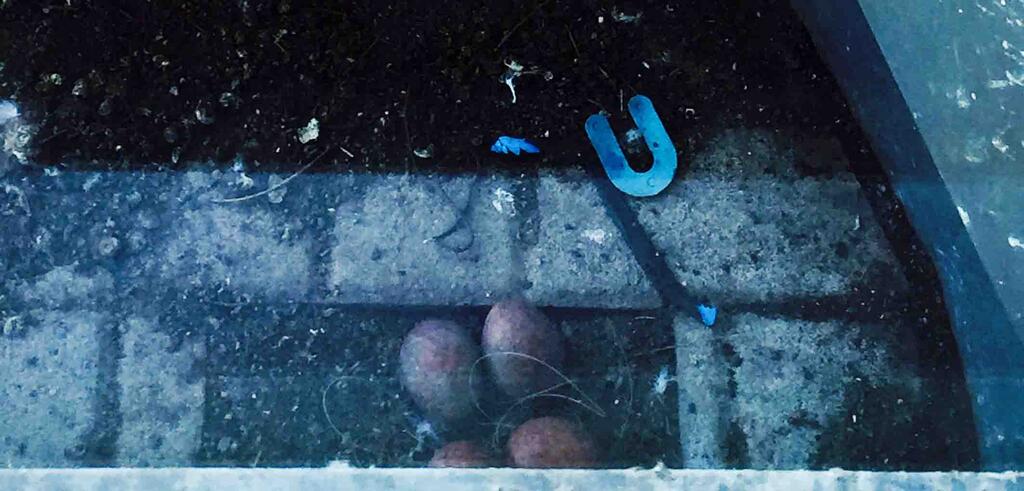
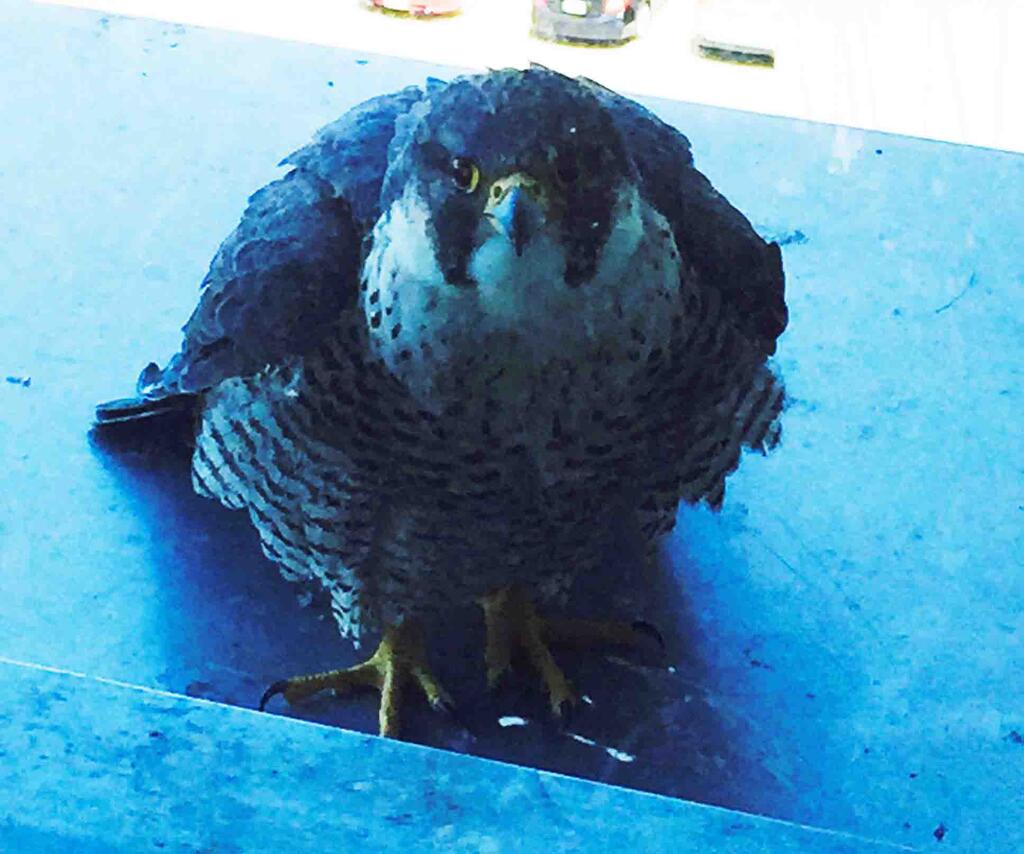
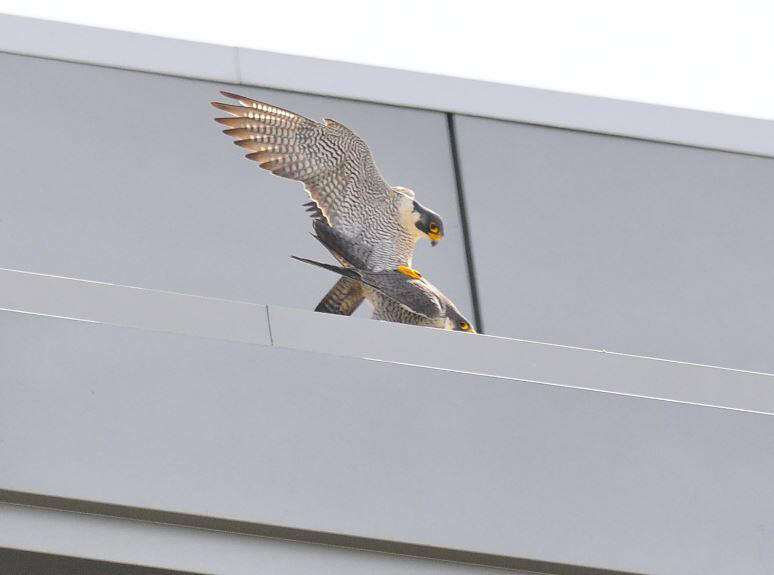
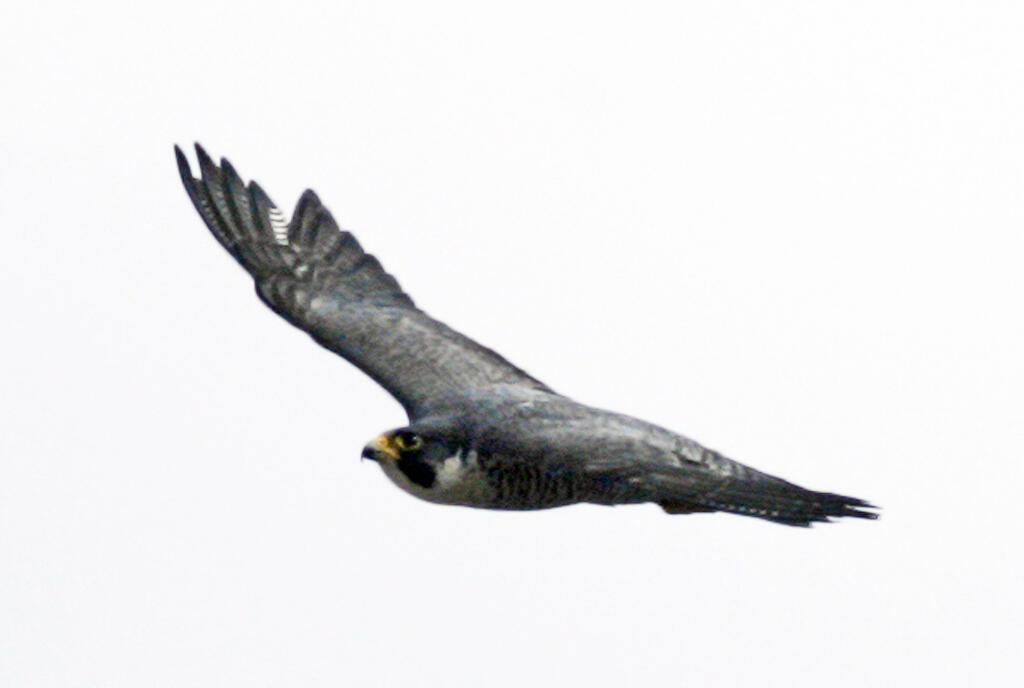
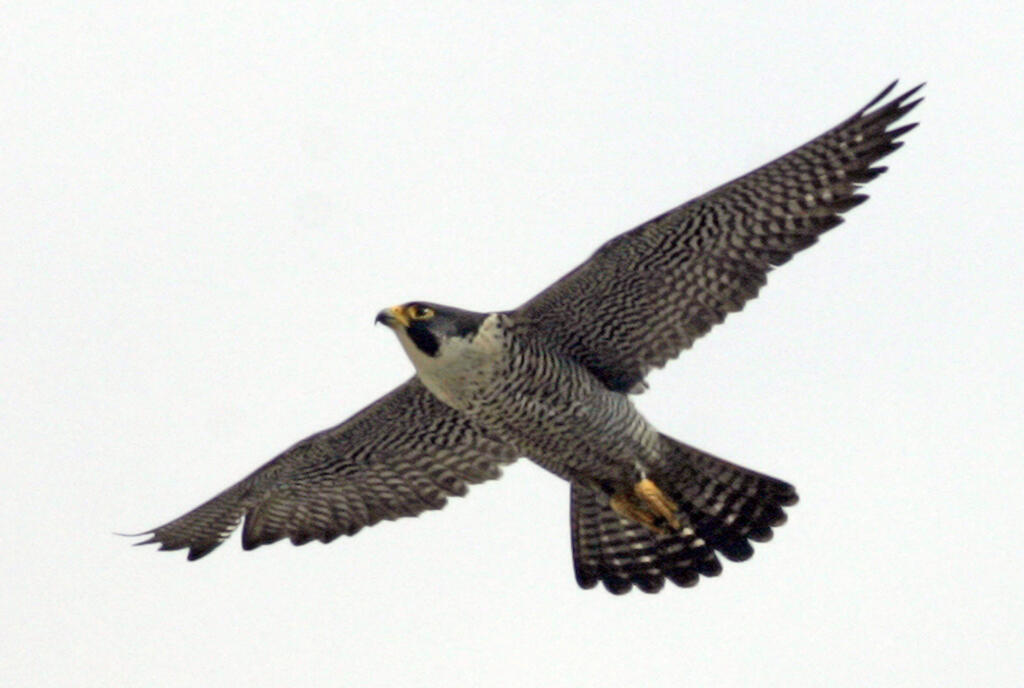
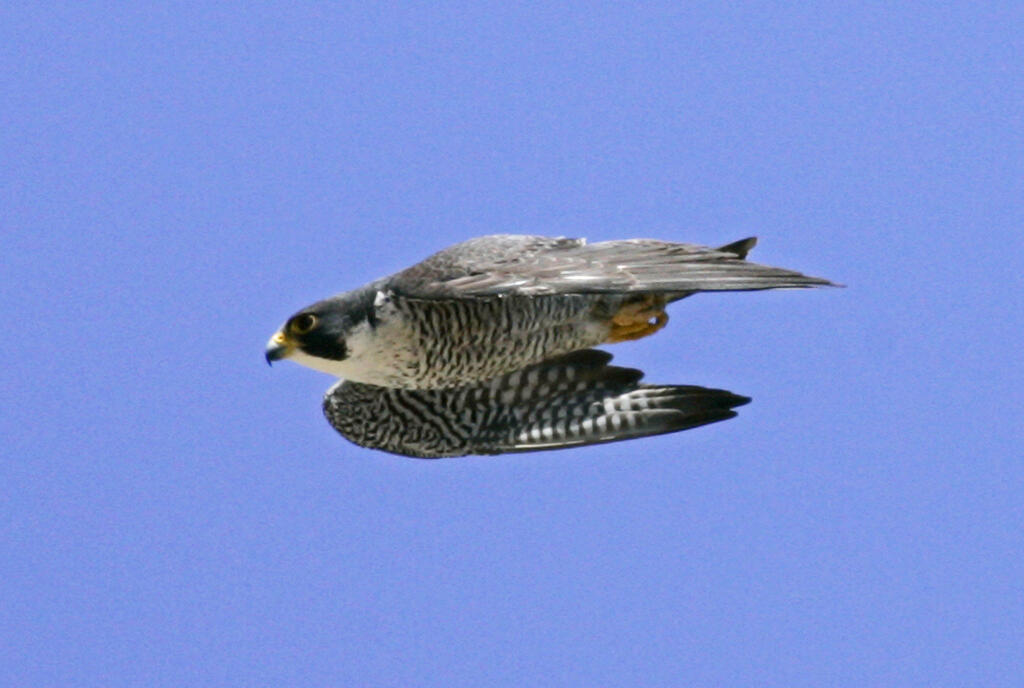
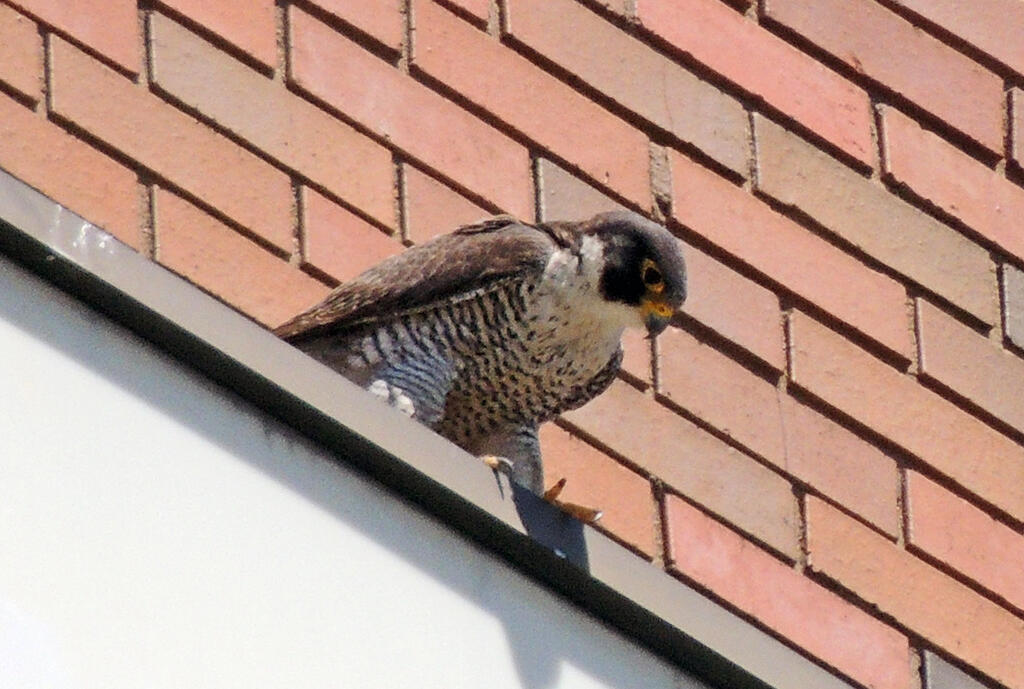
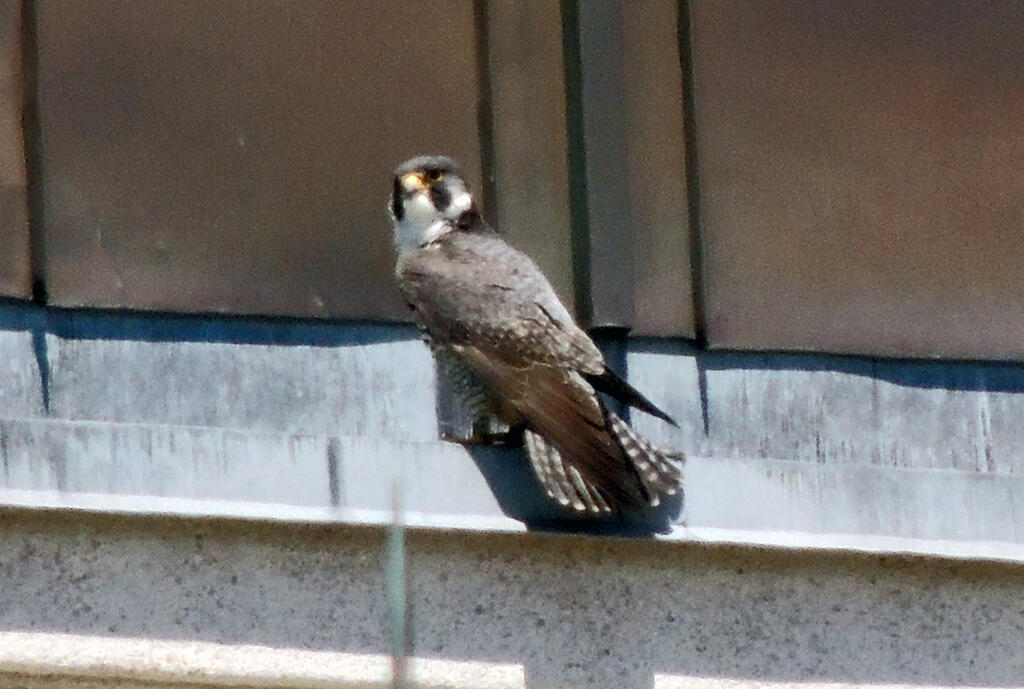
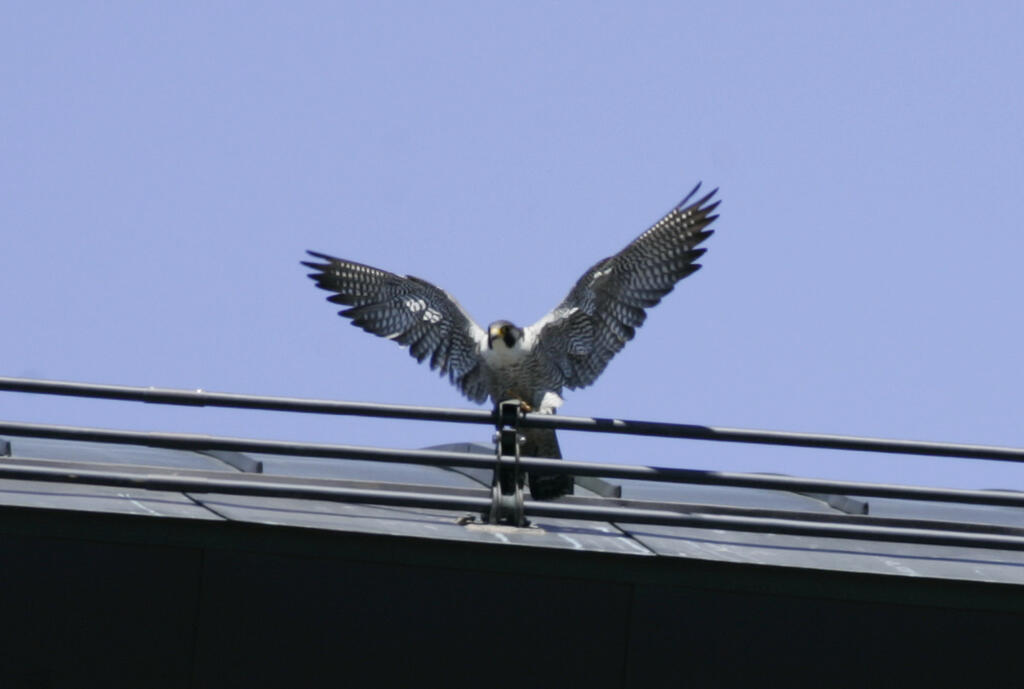
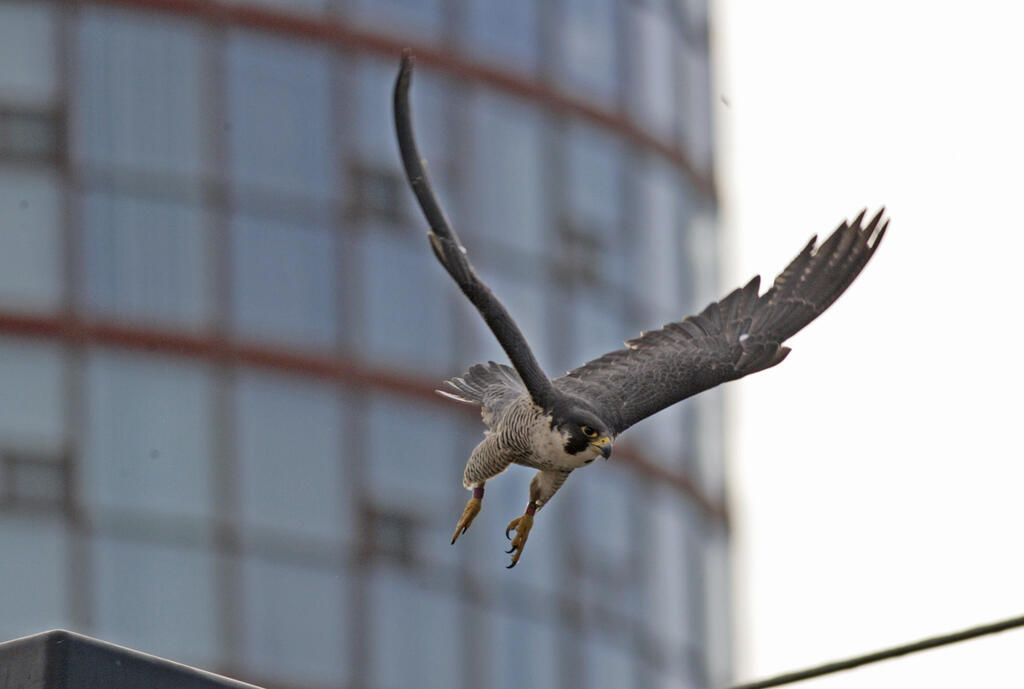
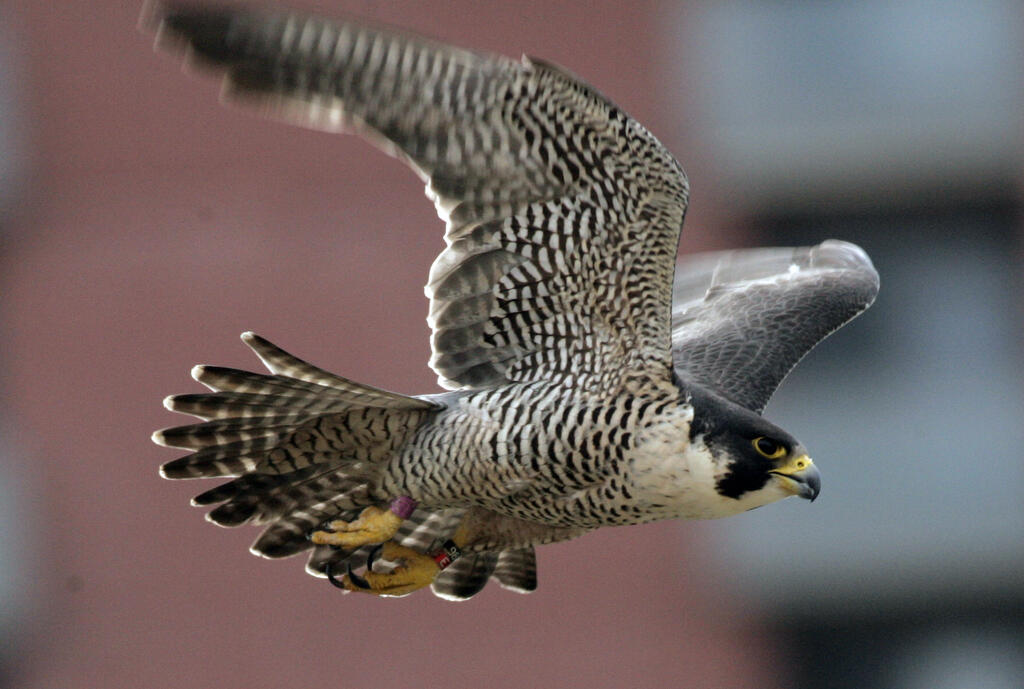
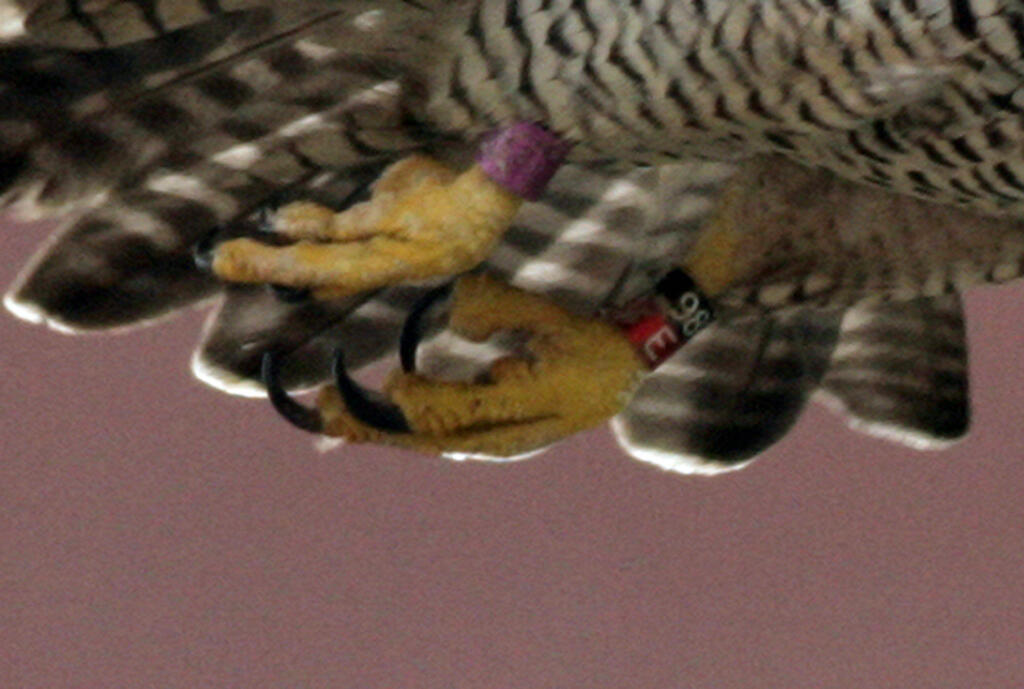
CPF volunteers have been watching the Peregrines on the courthouse closely and determined that they were on eggs for sure and in full time incubation for a least a week. Well they were correct good observations folks. I asked Melanie from CBRE to have a look for me a take a photo if possible and here are the pictures she sent me thanks Melanie!
Posted on April 29, 2015 1:58 pm
April 21, 2015 - Brampton - Courthouse
Marion Nash Reports:
As witnessed by Toivo earlier in the week, mating continues at the Brampton courthouse. The pair, who have claimed the courthouse as their own, are an unbanded female and a banded male 97/Y and his name is Striker. (Tracy can you insert some info on Striker, how old, hatch location.ect)
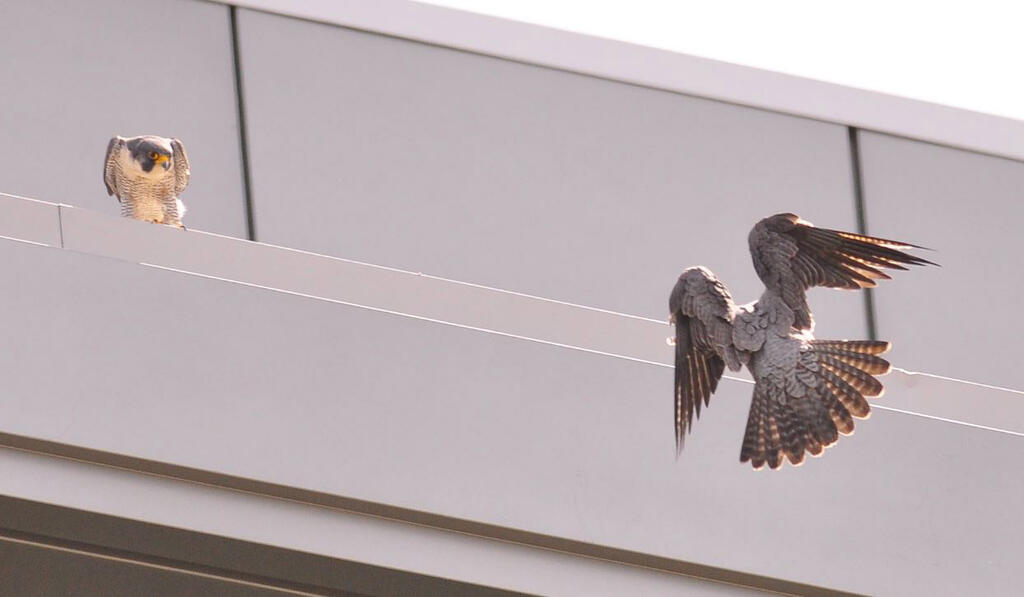
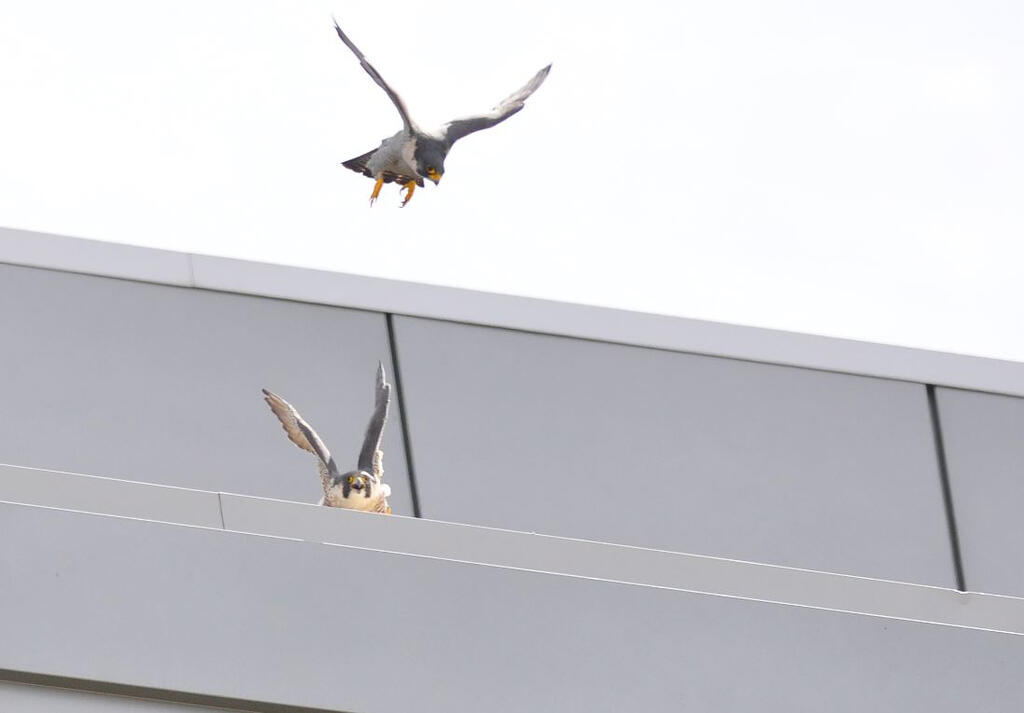
The pair can most often be found on the north ledge of the courthouse however this is often too close for comfort for another nesting pair of falcons who call the courthouse home. On the other side of the courthouse are a pair of American Kestrels; our smallest falcons. At the moment, you may be lucky enough to see the two having quite the midair battle.
Incredible speeds and stoops can be witnessed as the kestrels try to scare off the peregrines. So far this behavior has been unsuccessful on the part of the kestrels. Hopefully, we will see two active and successful falcon nests in the near future!
Posted on April 21, 2015 11:26 am
April 14, 2015 - Brampton - Courthouse
Marion Nash Reports:
Interesting week in Brampton march 30th … was the first day we observed a male here with the female that has been here all winter. He was very small with a heavily barred breast , he may have been here for a few days.
By Sunday he was replaced by a larger , lighter coloured male.
This photo was taken on the 31st and is the newer male.
Friday the 4th , copulation was observed twice. and today she was on the balcony below the top ledge , outside the glass, walking back and forth and turning around. There is a spot at each end a triangle shape about 3ft long by 2ft at the widest that may have gravel.
Because it is on a balcony with glass panels it would be a problem.
We are hoping for a better result than the last two years.
Ok looks like we are serious at the Courthouse ….
last night definitely One bird …. then at 645 am the female was on the North ledge and as I changed positions , she disappeared ..I believe she walked back in … and this evening at 730 pm both falcons there and looking very comfortable.
he was on the north ledge closest to #10 and she was top NE corner , close to the spot on the ledge that she seems interested in.
Since Winston spotted them there every time I have gone by …. at least one falcon has been on the building.
I have taken to calling her ….. Hope …. as in …. Im really …. really hoping things work out well this year for Peregrine falcons in Brampton this year.
Fri morn at 645 she walked out from NE the corner of that ledge and after 3 mins left and headed south. No sign of male.
Spent two hours poking around Fri evening , Nada found her downtown on George st at dark no sign of male.
Sat morning , out early nada either location, around 10 am found 1 downtown moving around a lot bldg to bldg, agitated.
Ten minitues later, saw two wheeling around over the 4 corners, I was moving , dont know M or F. but exact same size, ignoring 2 pigeons that flew right close to them.
by 1020 a Female(very dark) settled in on a bldg and ate. Then was still very agitated, moving around every couple of minutes.
I suspect that they saw another Peregrine from the CH and came back downtown. and are still fighting over territory.
all I can do is keep watching.
Still weird out here in Brampton. Back and forth between downtown and the Court House.
Sat evening at 730 … female on the CH north ledge. just sitting … then Sunday nada till I found two downtown on George st at 1pm.
In the evening, Maria and I went on a tour , ending up at the CH. At 730 a peregrine came in and circled the building … alighting on a cell tower south end. It ignored 3 pigeons below it on the library roof.
It took off over our heads and I realized it was the small Male with the almost darkly coloured breast (not the male in Winston’s and my pics) that I had first seen downtown the week earlier…That was replaced at some point.
He buzzed the yellow apartments south. ( about 600 yds SE of the Court House)… then suddenly we had three peregrines … the female had come off the roof of the Apts and joined in the chase.
It went out of sight … but the Female returned and landed N side kind of mid roof and walked in out of sight …. she reappeared in about a minute …. and sat there … we left her there…
last week I mentioned that she was very agitated one time I watched her downtown.
Then just for S&G.we checked downtown to see if we did have two pairs …. fighting over territories.
All I can do is keep watching.
I observed copulation sat midday. and last weekend. So she has to be ready to lay eggs …. just where.
This morning at 630 … a female was on the East corner of the North ledge of the Courthouse… she left and mated with a male at 645 … and he went out on a hunt west. at about 650 am.
Winston texted me and reported Pefas on the north side midmorning and Maria observed two Falcons on the courthouse …. mid afternoon.
Six minutes later she was Downtown and observed our spare male Peregrine …. Downtown on the George st building.
We have had some real drama here in Brampton …. but it seems settled that the lighter …. slightly larger male is the man. Sunday evening the female helped that male chase off an interloper. She has been on the courthouse almost continuously since Midday Sunday , and mating has been observed twice.
The primary site of interest is a spot on the East end of a ledge on the North side of the Brampton courthouse Hwy 10 just south of Steeles.
I will be doing early Morning and evening checks , Winston will be providing midday observations until we have established that we are hopefully in the family way here in Brampton.
Winston, Toivo and Maria
Posted on April 14, 2015 1:28 am
June 06, 2014 - Burlington - Lift Bridge
Bruce Massey Reports:
On Friday I was out to do the closing shift at the Burlington Lift Bridge and not a lot had changed with the status of both boys. Ireland was still not in our sights after his flight earler in the week that ended up with him in a tree on the Burlington side of the canal near to the CCIW building. Every day watchers have been searching for him since he left the tree but without any luck seeing him. He could very well be moving through the area and yet we haven’t been able to catch sight of him due to the thickness of the trees on that side. Today was no different in that we continued to check around in the hopes of getting an angle on his location.
Ghent was still in the nest box when I arrived and although he was flapping up a storm he was still hanging on to his home turf. The adults weere not as active as I am used to seeing at the bridge so they are clearly weaning him to encourage that first flight. At dusk he was still in the box but looking really ready to get going. I suspect that he will be taking off some time over the weekend and I will be back tomorrow to help on site.
Thank you to Bill and Sue, David and Rob, Barry and all of the other watchers that have been out and around to help out. I think we’re in for it tomorrow!!
Posted on June 8, 2014 8:11 am
May 28, 2014 - Brampton - Courthouse
Tracy Simpson Reports:
On Sunday Bruce, Toivo, Maria, Grace and I gathered together in Market Square to confirm whether we in fact had a hatch at George Street. When I arrived there wasn’t a great deal of activity but the male did come in from the north and land on the nest ledge. There he sat for quite some time preening and napping when suddenly he took off with purpose. This appeared to be a hunt. He suddenly appeared back at the ledge about 10 minutes later but didn’t stay very long. He was off and came low right over to the BDC building and landed on the sign just above the square. We were able to get the scope on him and confirm his identity as Striker, banded Black 97 over Y, from the Yellow Pages nest site in 2011. He didn’t stay long and was off on a hunt again this time staying away for quite some time. When he finally did come in he brought a small parcel of food which we all hoped was going to go into the ledge for hatchlings. Midnight appeared, took the food and flew over to the Canacord building where she consumed the piece. While there we were able to confirm her Black 98 over Red E recovery band assuring us that she was still the lady in charge. After eating, Midnight flew off to the east out of view while Striker remained in the nest ledge.
We were all so hoping to be able to confirm a hatch on Sunday but after 5 or 6 hours we can safely say that there wasn’t a young one yet, at least as of Sunday. If there is to be a hatch it is very close and the signs that the Brampton team are reading fall right in step with a hatch to come. Hopefully we will be celebrating young ones soon and we will keep you informed.
Thank you so much to Toivo, Grace and Maria for your continued monitoring of the nesting activity of Striker and Midnight. Your efforts on their behalf are amazing!!
Posted on May 28, 2014 6:52 pm
March 23, 2014 - Brampton - Courthouse
Tracy Simpson Reports:
This winter, the Hwy 10 corridor north into downtown Brampton has been rather quiet. For the most part, watchers were only seeing Midnight, the resident female, hanging around and her appearances were even then sporadic. Over the past week or so, the level of activity has certainly increased with the re-appearance of a male in the territory. While we have not confirmed who the male is yet, we can say for certain that there is a territorial pair. This excerpt is from a report that has come in from Toivo, Grace and Maria, our key Brampton watchers.
Don’t know who he is but yesterday Maria phoned me to tell me she and Grace were looking at a pair on the BDC building. Today I sat and watched as they checked out the top ledge at the George st condo…. in and out of the ledge between the uprights, heads bobbing and talking the whole time. Then a pair flight , quite comfortable with each other, so he has been there a few days. We will keep you updated as well as we can but too high for good pics that would ID him. If I can catch him on the BDC bldg we will give it a try. Its Midnight …she is much lighter on the back now but last week I got a good look and saw both bright leg bands!!
Toivo , Grace and Maria
Posted on March 23, 2014 1:28 pm
January 20, 2014 - Brampton - Courthouse
Tracy Simpson Reports:
I received a recent update from Toivo that Midnight is still being seen in the Brampton area along the Hurontario corridor. While she is not always at George St. and not always seen daily, she is still making appearances in downtown Brampton and its environs. Toivo has been keeping an eye on our Brampton pair this winter and he has noted that he has not been able to get eyes on Striker since November but that Midnight is still sporadically visible. Thank you so much Toivo for the update and as we march towards spring we hope to see where Midnight settles and whether Striker returns.
Posted on January 20, 2014 11:51 am
May 26, 2013 - Brampton - Courthouse
Tracy Simpson Reports:
Bruce and I spent several days over the past few weeks at the Brampton nest site to check in on the resident adults and their progress towards a hatch. Our goal was to confirm two important things; whether a hatch had occurred and the identities of the resident adults. While we knew that Midnight and Milton started off this season’s nest, our watchers Toivo and Grace in Brampton have noticed odd changes in behaviour and roosting sites of the resident male Milton and so we added confirmation of identities to the checklist.
On Friday May 18th, Bruce attended the site in the afternoon to check things out. When he arrived, he had both of the resident adults in view for prolonged periods of time which is uncharacteristic of adults with young. Neither of the birds entered the nest cavity where the eggs were believed to be laid on the George St condo for more than a few minutes and clearly they were not brooding or incubating. As they had already surpassed the projected hatch date of May 15th, it looked as though the nest had failed. Their chosen perch on the condo overhang is very high and therefore confirmation of the adult’s identities would take time and effort to achieve. We had to wait for the pair to come down to a lower perch for a view and we had to hope that while they were on either the BDC building or the Canacord building that they would expose their bands for us to read. That was not meant to be on Friday and so we made plans to return on Sunday May 20th for another try.
Bruce was on site in the early morning and was getting set up in Market Square when the adults came low. While the pair were on the BDC sign and quite visible, Bruce was challenged in getting set up for a view as the long weekend activity in the square was extremely busy. Once set up, as peregrines always do (to me anyways), the pair took off of the sign and returned to the high ledge of George St where they took up roosting positions for the afternoon. I arrived by midday and found the pair right where Bruce left off seeing them on the condo. I joined Bruce in the parking lot to the east of the condo where we set up camp for a good days watch. For several hours the birds slept and preened while we sweated and hoped they would soon spring to action. We talked with many of the local residents about the pair and the community is really excited about their presence. The adults moved very little from their chosen spots on the ledge with the male occasionally trying to encourage the female into the recess next to where she laid her first clutch. She was only vaguely interested and didn’t follow him in on the several attempts that were made by him to draw her in. Finally at about 4pm, the male took off on a hunt and disappeared from view. This drew off the female and the pair was airborne. I wandered over to Market Square to take a look and found that the male was hunting over by the BDC building. He landed briefly on the sign and I was able to take a few shots of him in the hopes of catching his band in the pictures. He flew off low toward the northwest and I was able to get a single shot with legs exposed but the band was not legible. After he took off I headed back over to the parking lot where Bruce was and he told me that both adults went whipping through to the northwest on a low trajectory. I know that Midnight often hunts over at the Go Station so off I went in pursuit. I struck it lucky and found the female on a low lamp standard of the Go train platform and I raced around and up the stairs to get a view. I was able to capture several shots and can confirm that Midnight is still the resident female in downtown Brampton bearing a black over red band marked 98 over E. I couldn’t find the male and so back I went to the parking lot. We waited anxiously for the return of the adults to the territory and after several hours, we finally gave up. They both had taken off to the south out of our view and we decided that the male’s identity would have to wait for another day. We headed south on Hurontario in search of the pair but did not succeed in finding them so we closed the day with both success and work left to do.
I went back to the site on Tuesday afternoon and found the pair doing what they love to do most; roosting on the George St condo overhang. They were like a pair of bookends with one on each corner. I decided that I wasn’t going to wait out the afternoon but instead wait for at most an hour and I was rewarded for my efforts. The male came off of the condo and landed on the BDC sign! He was only there for a few minutes but enough for me to get a few pictures of him while he roosted. Again the photographs only served to confound me more than confirm his identity. He took off of the sign and flew back up to the high overhang on the condo and at that I took my leave.
We have confirmed based on the resident adults behaviour that the clutch of eggs on the George St condo has failed. Sadly it may have been due to the cold and damp weather we have experienced this past April that has caused many other sites to also have one or two eggs fail to hatch. As a first time nester Midnight is still very young and that may have contributed as well. During our time observing coupled with the reports from Toivo and Grace we can also confirm that the pair is not mating at this time and therefore a re-clutch will most likely not occur this season. The only remaining question to answer is the confirmation of the identity of the resident male.
Yesterday, May 25th, Bruce and I again headed to Brampton to confirm the male’s identity. By hook or crook I was determined to get it as this little male was vexing me now. He teased and taunted with brief looks at his legs and finally… …eureka!!! I got it!! The resident male in downtown Brampton with Midnight is none other than Striker, banded solid black 97 over Y with blue tape that is still visible, who hatched in 2011 at Yellow Pages to Linn and Rueben. We are unsure where Milton is but we hold out high hopes of his discovery elsewhere as he is a tough old guy and quite tenacious. One thing we can say is that Striker is now the resident male in the downtown core. A huge thank you to all that have assisted and watched the pair with a special thank you going out to Toivo and Grace for their time and efforts. It is greatly appreciated and we are very pleased to see this pair so well supported.
Posted on May 26, 2013 10:51 am
April 16, 2013 - Brampton - Courthouse
CPF Postmaster Reports:
We would first like to thank all of the watchers that have been keeping an eye on the pair in Brampton and their progress. Toivo and Winston are an invaluable part of the Brampton watch team as well as Bruce and Tracy making forays to help out on weekends. Both Toivo and Winston have been watching Milton spending time not only at the George St. condo with Midnight, who is currently incubating an unknown count of eggs, but also monitoring his activities at the Brampton Courthouse as well.
Over the past several weeks, Milton has been spotted on a regular basis at the Brampton Courthouse investigating the old nest ledge on the southwest corner of the building. He has not been alone! Both Toivo and Winston witnessed him at first hanging about with an unbanded adult and then later with an unbanded female juvenile from last year ( now a subadult ). During the past week, the frequency of these sightings have been less but it looked as though Milton might try to run a second nest with another female. A recent check of the ledge did not reveal eggs or an incubating adult and so, for the moment, it looks as though Milton’s nesting attention and energy is focussed downtown.
At George St., all of our watchers have been seeing both Midnight and Milton but for the most part it has been the male who has been out and about. Midnight is clearly incubating something on her chosen ledge and changeovers have been seen between the adults highlighting the fact that they do indeed have something that they are attending to.
Thanks to all who have contributed to the monitoring of the pair and we will keep you updated as to the progress that they are making.
Posted on April 19, 2013 12:07 pm
April 01, 2013 - Brampton - Courthouse
Tracy Simpson Reports:
Bruce and I were in Brampton on Monday to try and sort out just who is where and with whom. As you know, Milton is the territorial male and seems to be running two areas; the Courthouse and a condo on George St. Here is what we were able to ascertain.
Bruce and I went to the courthouse first. We found Milton on the backside of the courthouse on the ledge that he prefers. He had flown in with food, disappeared to the back of the ledge, vocalized and then reappeared. He wiped his beak off and then remained roosting for about 30 minutes. He preened and occasionally vocalized but other than that, he was alone. He took off to the east and then swung back around to the west side of the building. We went looking for him but couldn’t find him. We went over to Second Cup and watched from the windows there and after 10 minutes, he returned to the south ledge of the courthouse, again alone. He stayed 5 minutes and then flew west over the parking lot of Second Cup but I lost him as he banked around back behind the courthouse. Looked like he was hunting or chasing. He returned to the same south ledge briefly and then flew back around the courthouse and off in a stoop to the north. We left the courthouse for George St. and when I got there, I circled John St, east to the BDC, around the Rose Theatre and then to the George St. parking lot. No sign of Milton or Midnight. When I got to George St., Milton flew in and landed on the overhang of the condo on the south end and roosted. He was there for a good 10 minutes staring at the centre pillars. He flew off, circled and then came flying in to the pillar area of the overhang. That’s when Midnight waddled out from between the south and centre pillars and they mated. Milton then took off on a hunt and Midnight remained on the overhang edge watching. He must have been successful as she became very animated and excited. She finally took off east over downtown in pursuit of him and I lost sight of the pair. A few minutes later, they both came bombing back to George St; her in the lead with prey and Milton following. She tried for the overhang but fell short by a full storey. She had to circle around and then back up to try again. She has never had trouble flying to that ledge with prey before and makes me think she’s heavy with eggs. Both birds ended up disappearing between the south and centre pillars with much vocalization.
I would be willing to bet she has eggs already. I had that ledge in my sights for a full 30 minutes with no sign of her at all. She might have been lying down. When she did emerge, she looked a little dirty lending more credence to the idea that she might have an egg or more. So without seeing eggs firsthand, I would say with 99% surety that Midnight is with eggs on the George St. condo east overhang between the south and centre pillars with Milton. They are still copulating and she is still willing to leave the ledge for short periods and therefore the clutch is in the early stages and is not complete as of yet. Milton seems to be going down to the courthouse to hunt and roost away from the nest site and has attracted other females who he might be nesting with as well. I think this is an area for more observation. At George St., I didn’t get band numbers but can confirm the colour configurations as those of Milton ( black over green, silver USFW ) and Midnight ( black over red, purple USFW ). I have confirmed their numbers recently when they were low on the BDC. At the courthouse, I did confirm that it is Milton for sure. Winston and Toivo, our Brampton watch team members, have also confirmed the presence of an unbanded adult female and a sub adult female who was nosing in on the territory at the Courthouse. Is one of these females on eggs or in the old nest ledge scrape? Something worthy of investigation. I think the courthouse is the place to watch now and sort out whether we have a second nest on the go.
Posted on April 5, 2013 7:53 am