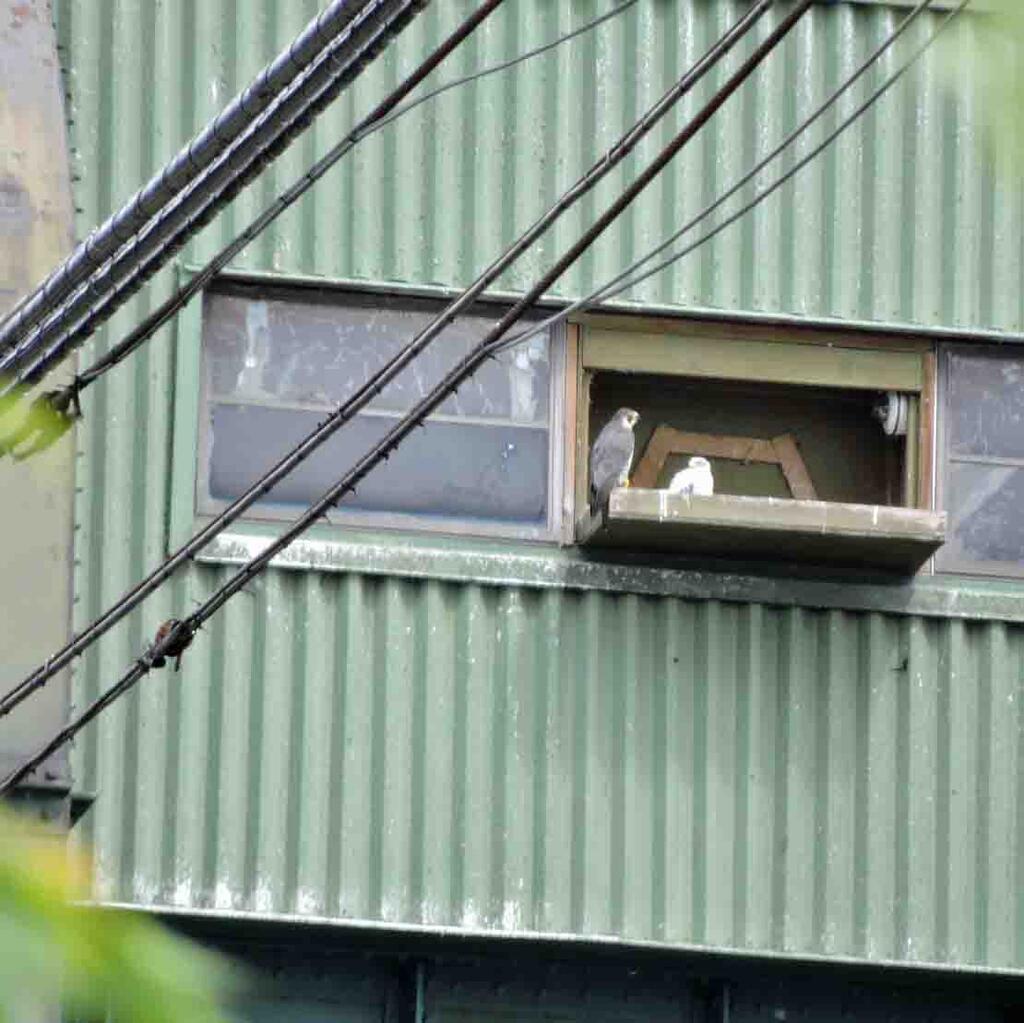
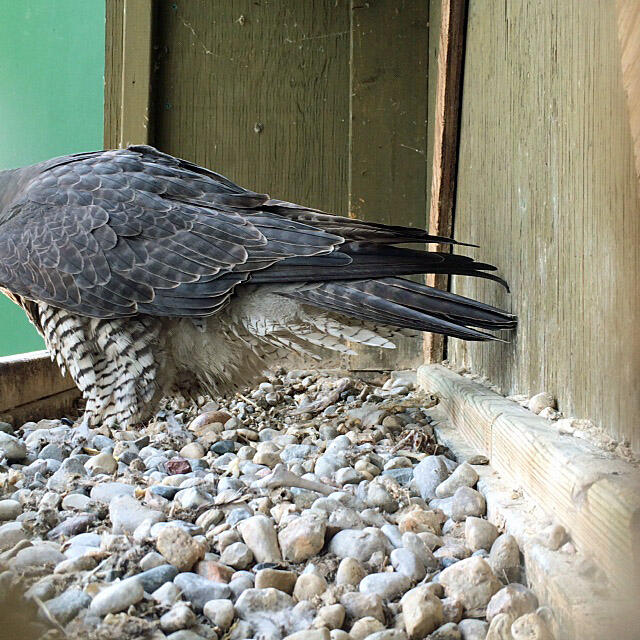
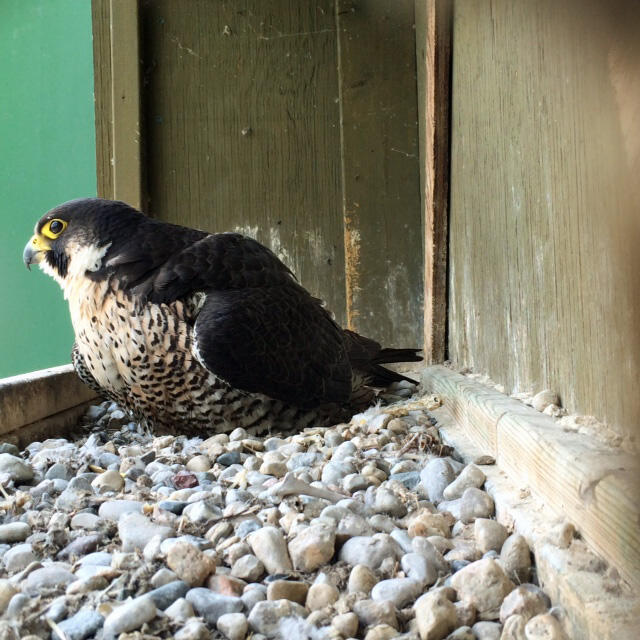
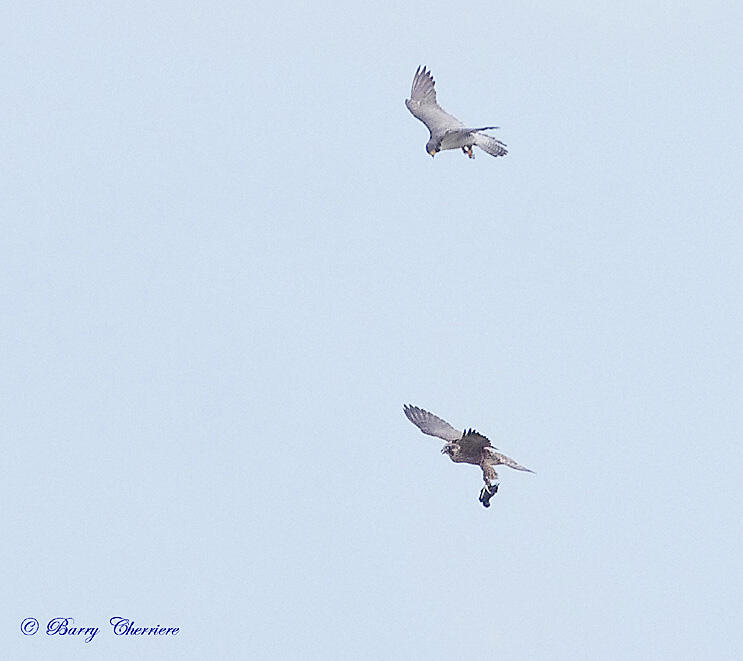
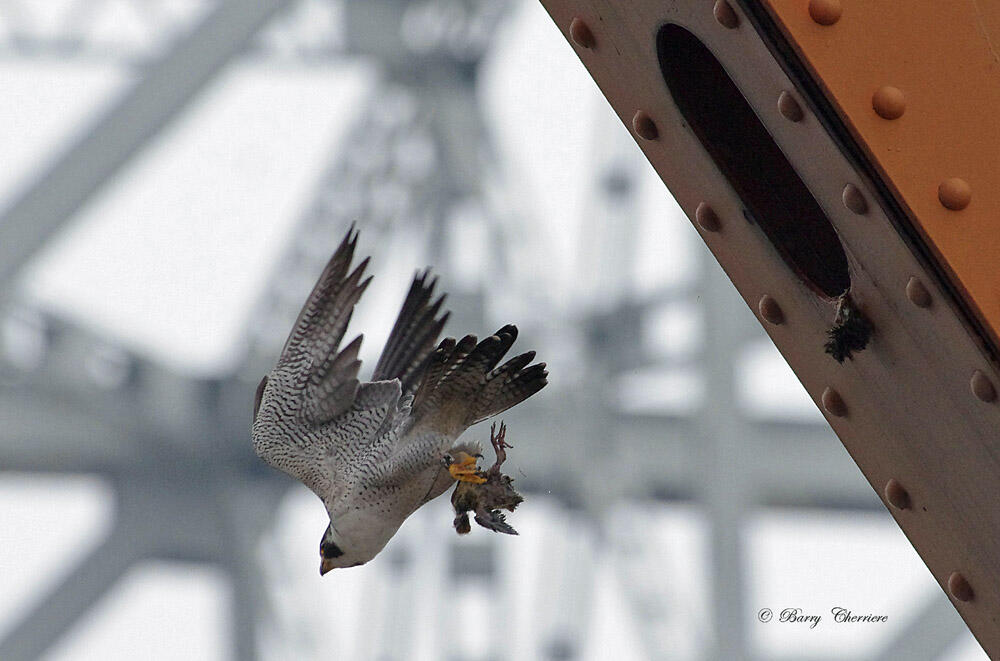
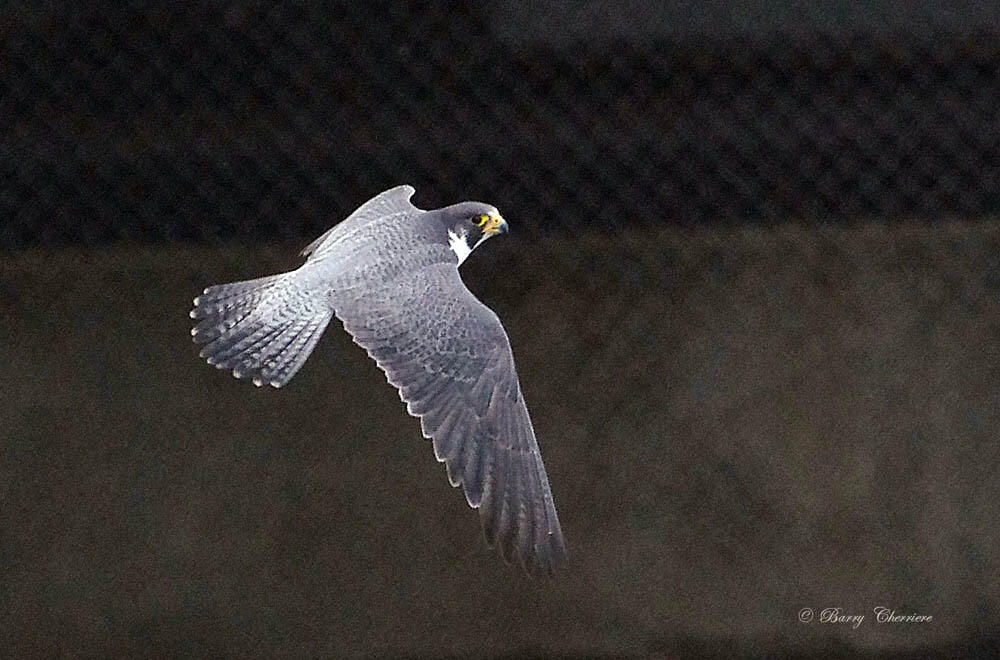
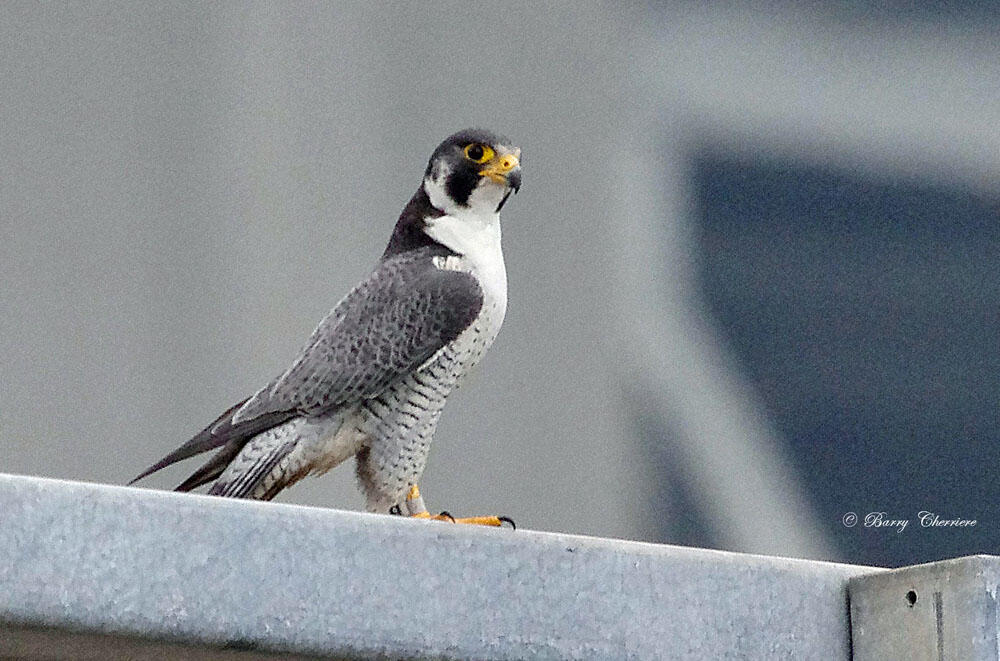
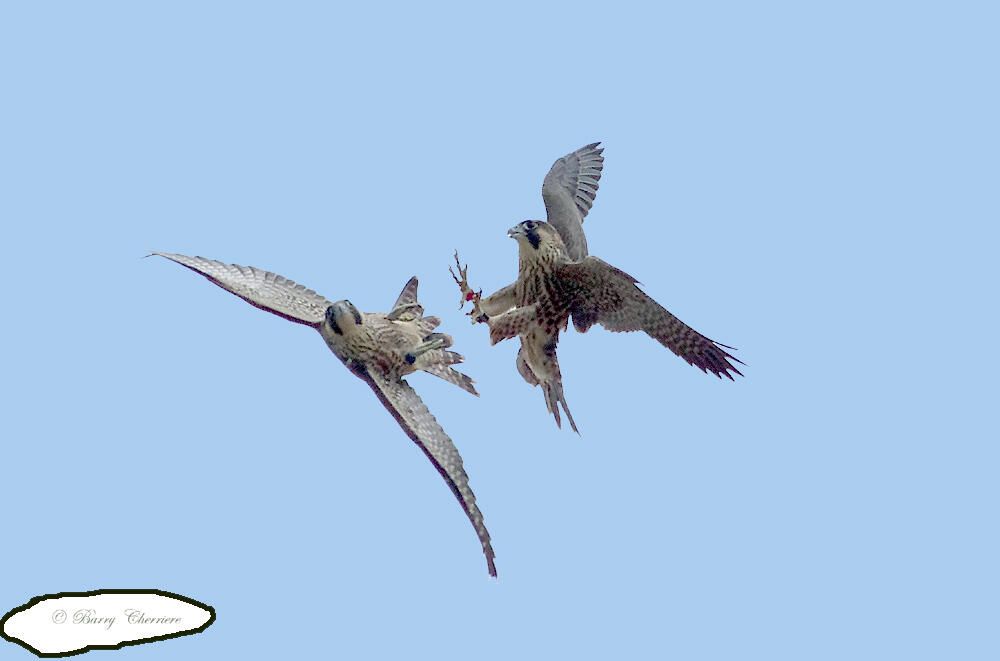
Bill and I stopped by the Lift Bridge this afternoon to see what we could see. After searching the Hamilton Hydro Tower and under the Skyway, with no luck, we decided to check out the other favourite spot, the face of the Hamilton Tower. Low and behold, there sat Mom and Dad just a few feet apart. (We are assuming it’s Mom and Dad as we didn’t get a look at any bands.) Mom appeared to be standing guard and Dad was enjoying himself preening. The pigeons were everywhere, so I guess neither were hungry as there was no hunting taking place. Looks like the adults are going to stay for the winter.
I found this article on a great site run by Kate St. John down in Pittsburgh. The site is called ‘Outside My Window’ and not only does she report on the falcons there but on various other species and wonders of nature! I thought longtime time fans of Pete would like to know how he is faring.
Here in Kate’s own words is the update and I’ve included the link so you can all see a current photo of him and keep track of his progress!
Pittsburgh Pete, as he was nicknamed in Canada, has been through a lot in his three years. He was born at Pittsburgh’s Gulf Tower in 2006 and flew to Burlington, Ontario where he nested successfully at the Lift Bridge in 2008. At the end of that nesting season he was gravely injured by a rival peregrine. He recovered from that injury but was attacked again, lost his nest site and nearly lost his life. He ended up in rehab last November at the aviary of Judy Bailey, an Animal Control Officer for the City of Hamilton, Ontario.
Though he’s received the best of medical care Pete has never fully recovered from his injuries. He has no detectable head or wing injury but he has seizures so he can’t be released into the wild.
As soon as his health improved Judy tried to find Pete a permanent home but it was hard to place him because of his seizures. His luck turned recently when Mountsberg Conservation in Flamborough, Ontario said they would take him for their Bird of Prey education program if he will sit quietly on the glove. All Pete has to do is learn a new skill and get clearance from Canada’s Ministry of Natural Resources.
To be an educational bird Pete needs to accept human contact from his trainers and tolerate humans nearby, so Judy is teaching him how. She writes, “He took to being tethered remarkably well! The day after I jessed him, he walked about a foot to my glove, latched on with one foot and ate the quail. By the 3rd or 4th day he hopped onto the glove and ate. Within a few days I was able to pet his feet, legs and belly. He’s not thrilled but he tolerates it. He will still get a bit antsy, at times, when I get close to the perch/booth, however, he quickly settles and eyes the glove. He’ll get very vocal with me at times!! …Incidentally, I have not witnessed a seizure since he has been tethered!!”
This is great news because Pete’s future hangs on his ability learn these lessons. I think he can do it. Pete’s a very resilient bird.
Barry Cherriere was asked to do a write-up for the Hamilton Naturalist’s Club news letter, The Wood Duck, of how the nesting at the Lift Bridge went this year. With Barry’s approval, I am attaching herewith his report.
Barry stated in his covering e-mail ” the general consensus was that the year didn’t go as well as expected, in fact it sucked. I am sharing with you the story that I submitted to them along with some images that went along with the story to illustrate some of the events that occured. I hope that you enjoy it.”
All photos attached are by Barry Cherriere.
The Burlington Lift Bridge Peregrine Nesting 2009
Barry Cherriere & the Lift Bridge team
We started the new nesting season with high hopes and enthusiasm after the great first nesting at the Lift Bridge last year. To start with I soon discovered that the adults were not the same ones as last year. In March the female from last year, who still remains a mystery as to who she was, was found dead on one of the ledges of the Burlington tower. The male from last year is in rehab, as he received head trauma in the fall of 2008 and was picked up by the Animal Control Services near the canal area and cannot be released into the wild.
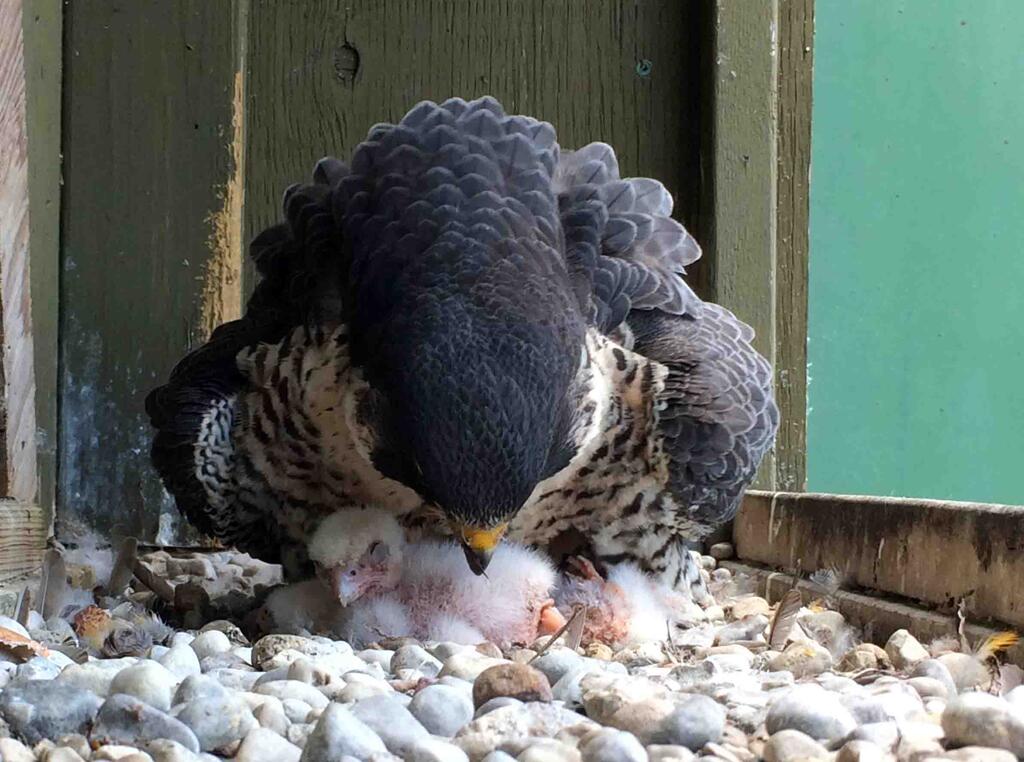
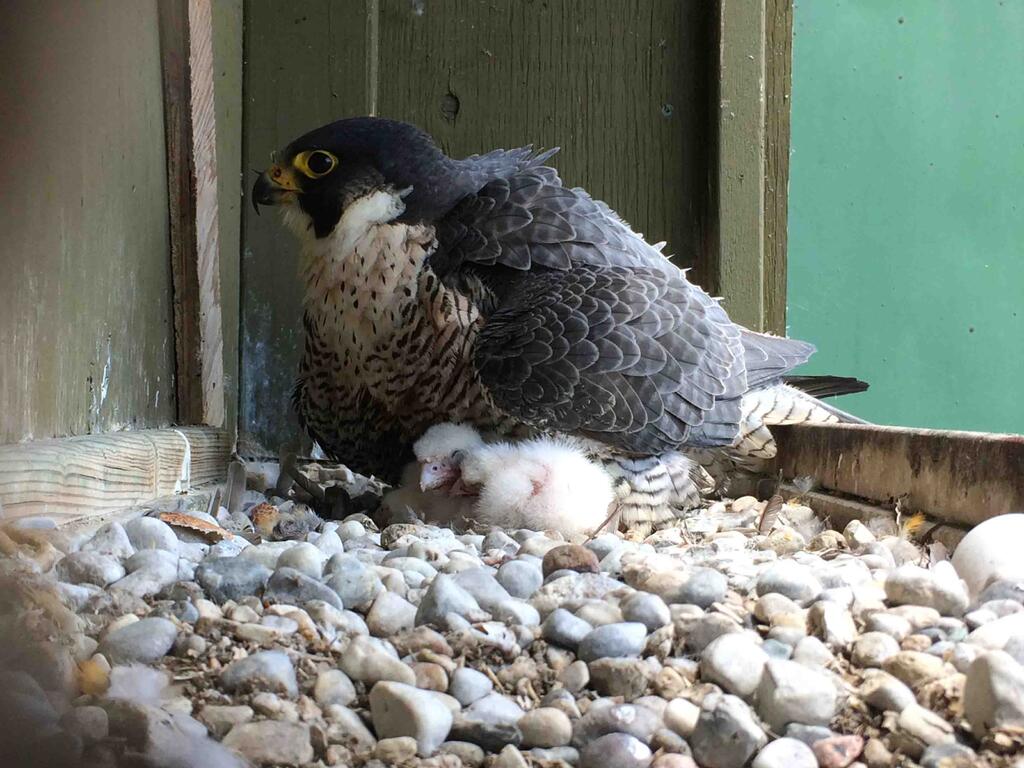
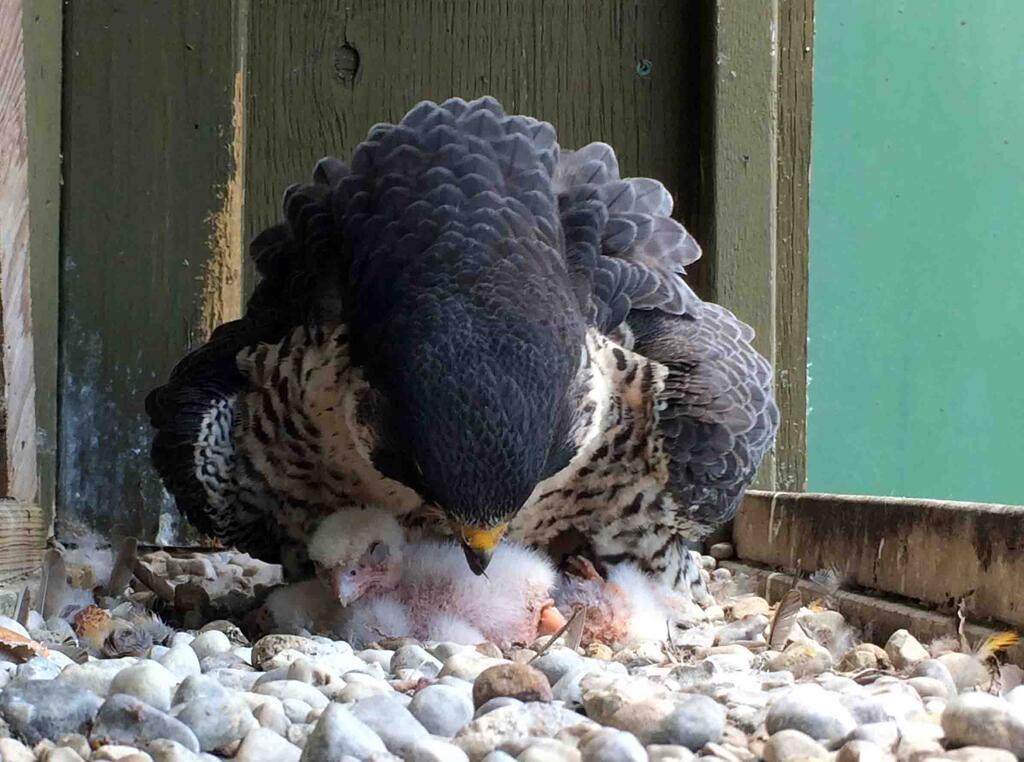
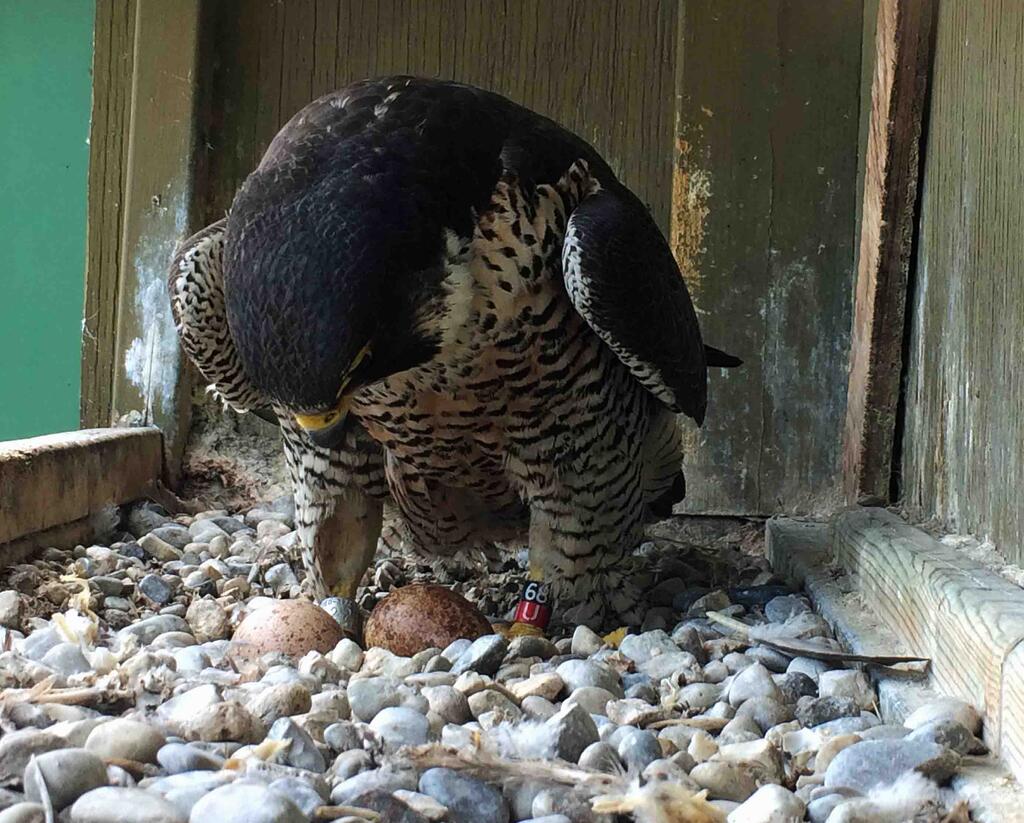
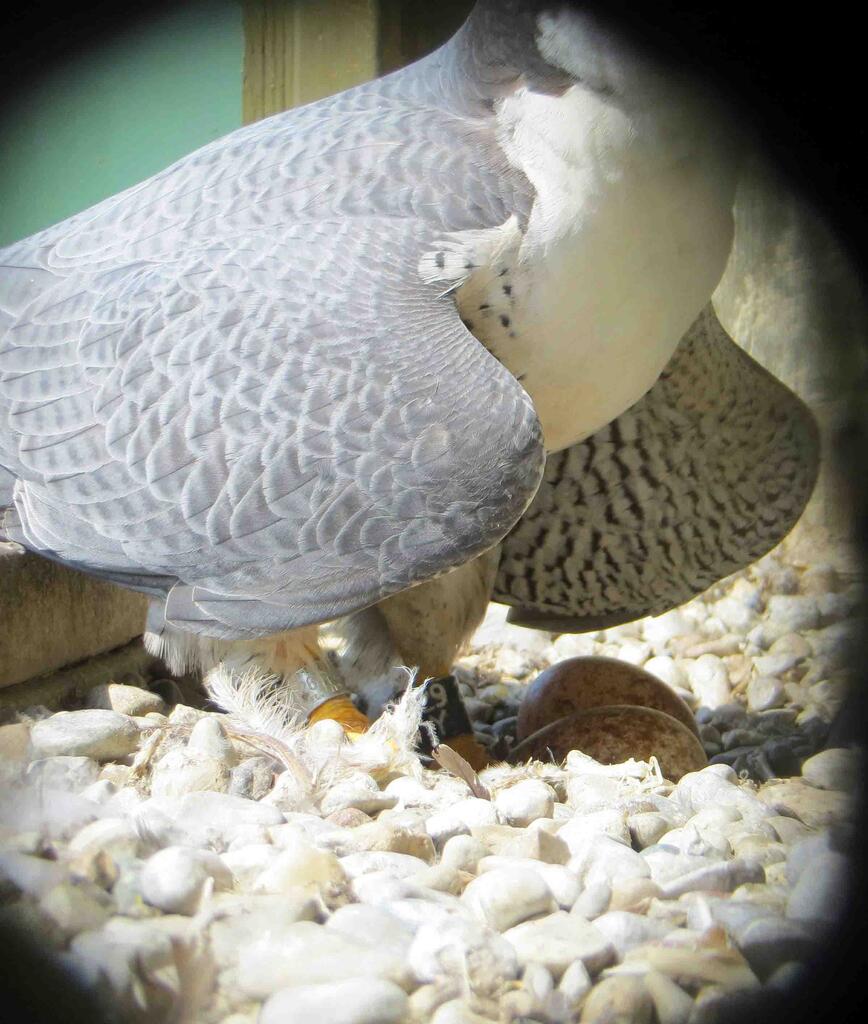
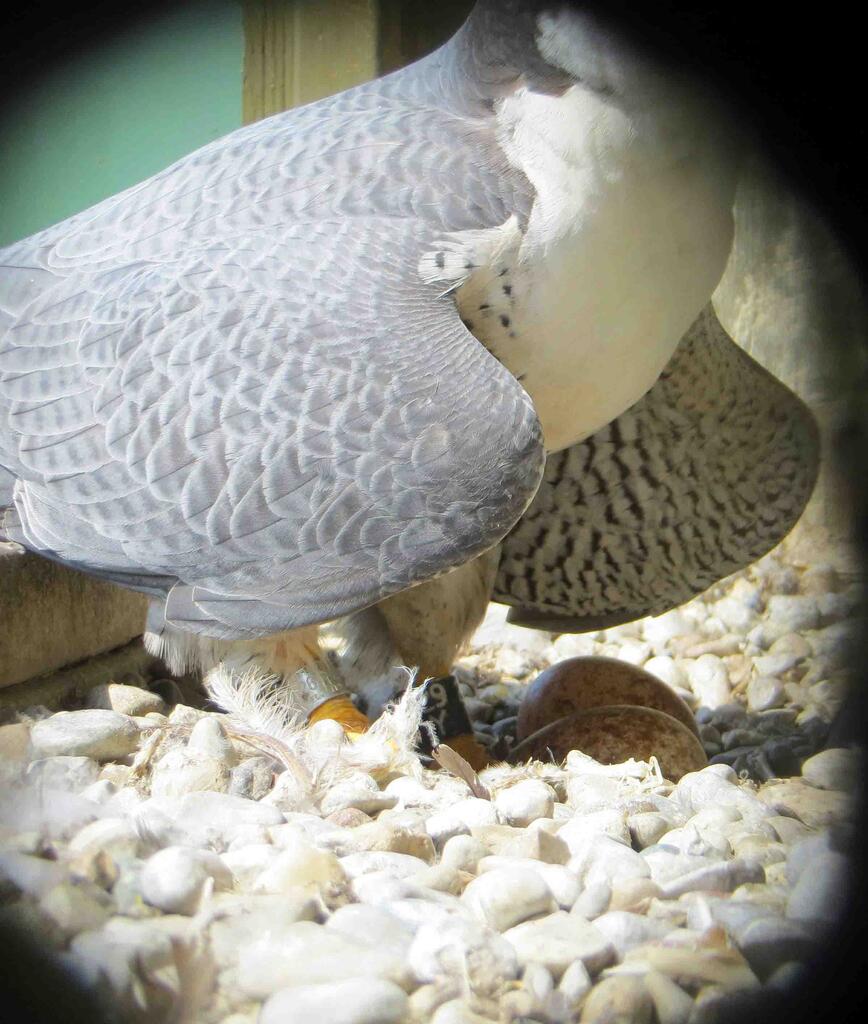
The new female, sitting on three eggs in late March, was banded as a chick, in 2006 at a nest site in Dayton Ohio and was named Cirrus. The adult male was banded as a chick in the same year at a nest site in Toronto and was named Sir Adam Beck. That made the two adults three year olds and this would possibly be their first nesting. We were about to witness what new parents they were and it left a lot of room for improvements.
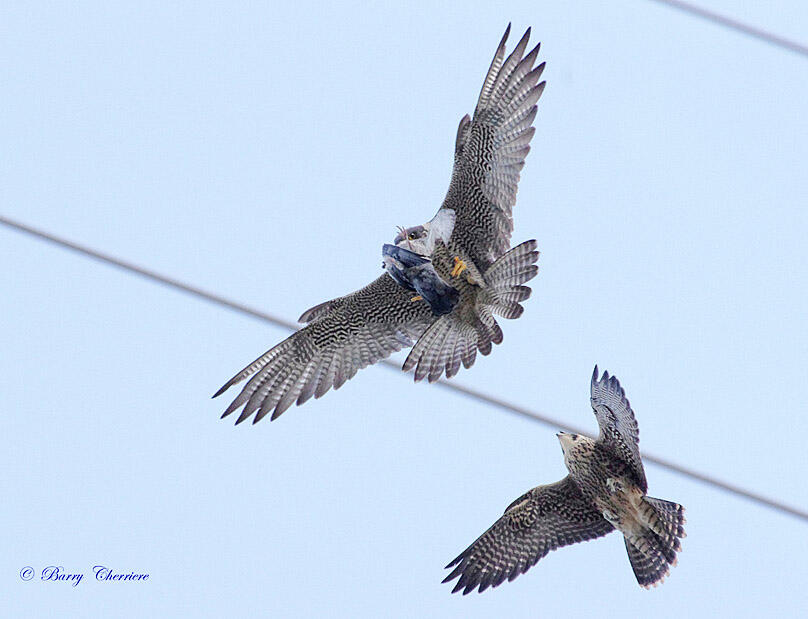
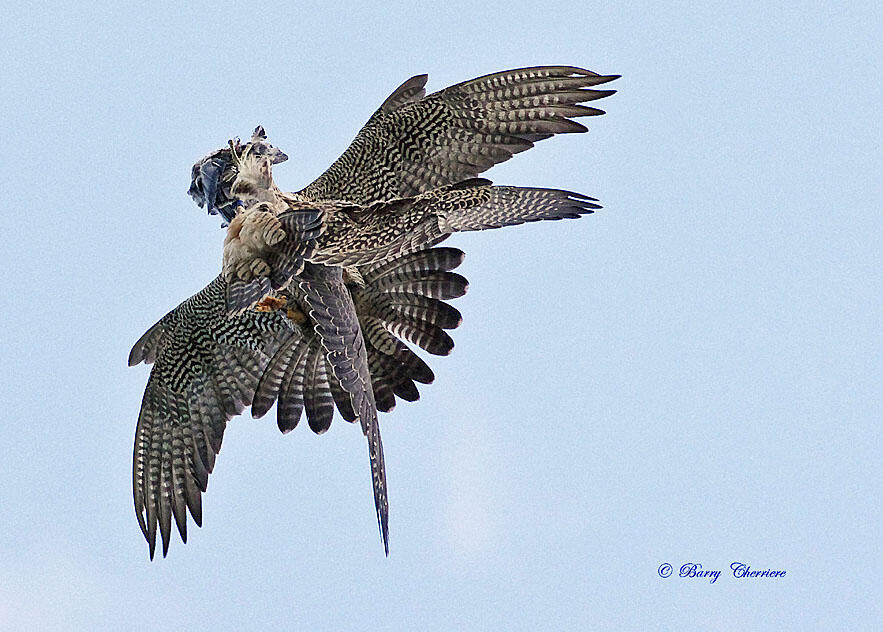
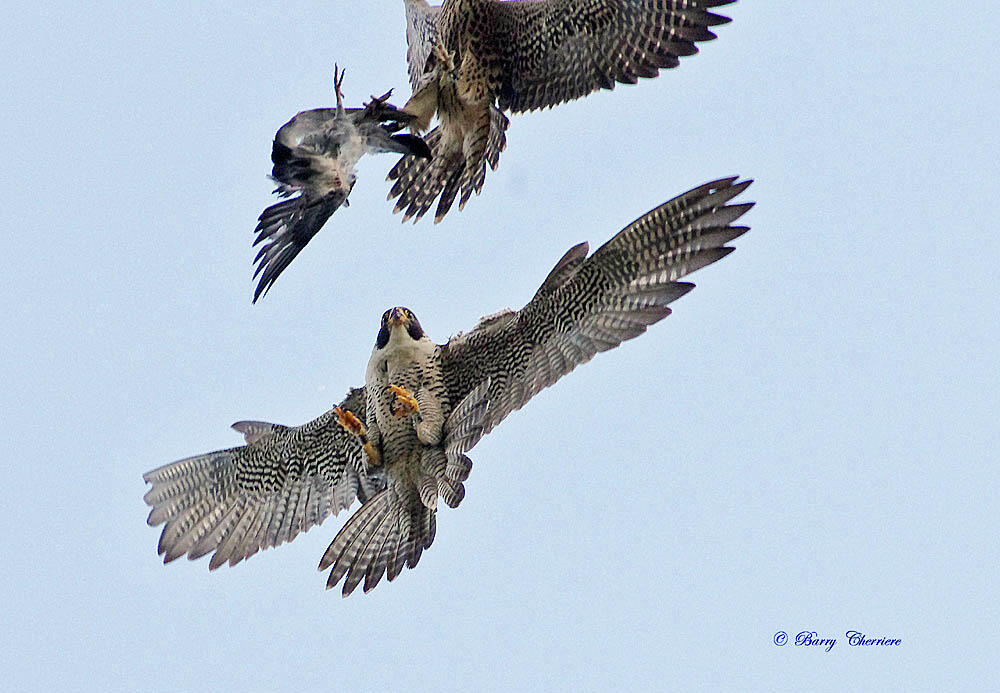
The male, Sir Adam Beck, seemed to have a fancy for and was very efficient at catching Blue Jays and orioles, while the larger female Cirrus stayed with catching Rock Pigeons as the main course. Cirrus did not seem to have the speed or accuracy that the male had. There were a couple of times where we felt that we had to lend our assistance to Cirrus in order for her to be successful in finishing the hunt. We were thinking of the juveniles as the meals seemed to be far and few between. I would constantly be informing the people who would come up to us and ask what we were watching for, that the Peregrine Falcon is the fastest animal on earth, well maybe not these peregrines exactly.
While the three chicks were getting bigger in the nest, Cirrus would maintain and defend a NO FLY ZONE near and around the nesting area. She would chase off gulls, cormorants and Night Herons if they strayed too close and any birds of prey were really big on her list of trespassers and they were not even allowed to be in sight. How would they know this forbidden area even existed until they wandered into it and by then it was too late. They were just cruising over, fat dumb and happy when all hell broke loose. Cirrus would leap off of the hydro tower screaming out her alarm calls. It would certainly get my attention.
On June 9th one of these occasions happened when an adult Bald Eagle was approaching from the south of us (Stoney Creek area). Cirrus came off of the hydro tower in a full red alert mode. I quickly grabbed for my camera knowing that this does not sound good and I don’t want to miss it. I looked ahead of Cirrus to see what her incredible eyesight had spotted approaching her area. It was an Adult Bald Eagle and she confronted it with no fear at all. The size difference was immense and she did not let that stand in the way of her mission to make sure that it was moving on. She stayed above the eagle and the eagle was forced to roll inverted to show Cirrus its’ feet and talons but she was not deterred. Cirrus positioned herself just off of one of the eagle’s wingtips and they were staring each other down. Wow if looks could kill! Cirrus escorted this eagle all the way to Burlington, screaming and diving at it the whole time. I will give her that, she backs down from nothing. That is probably how she was able to secure this nest location from the previous owners.
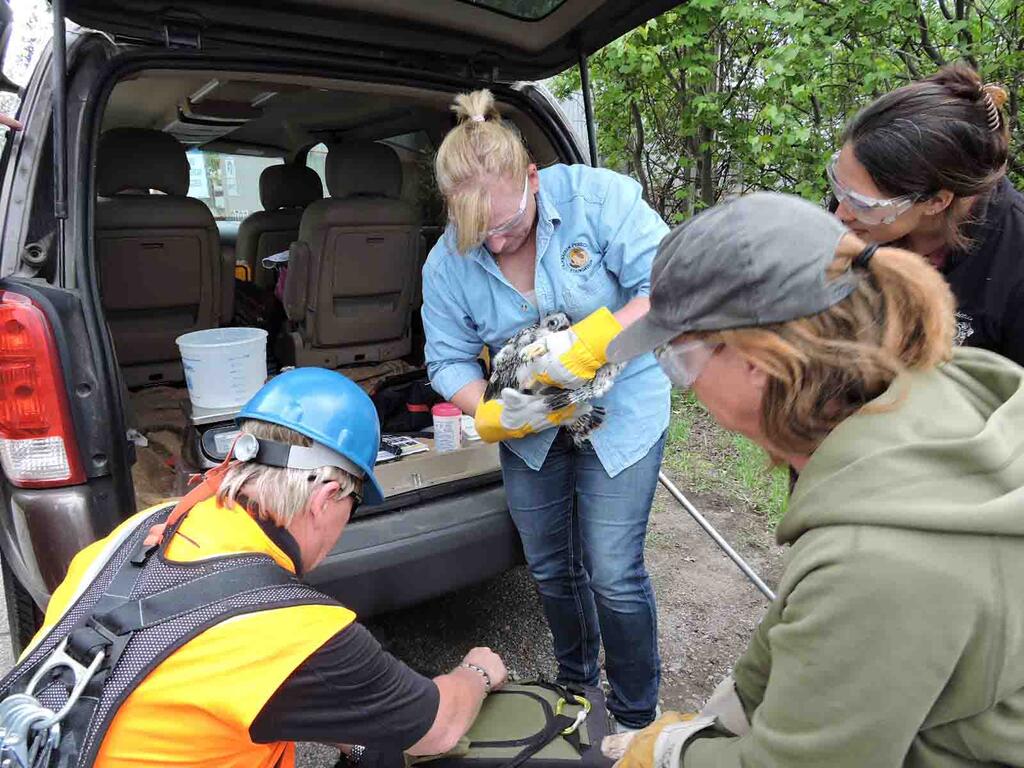
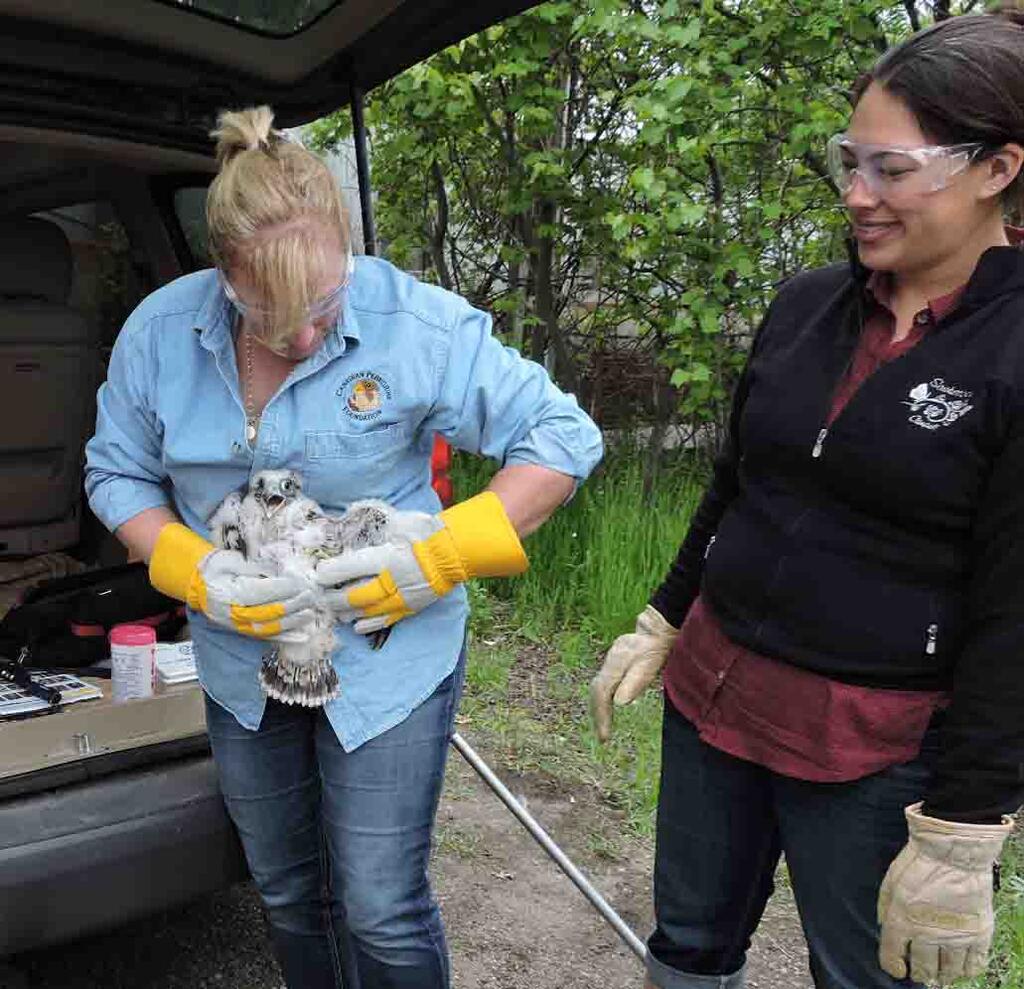
On June 3rd the chicks were scheduled to be banded by the MNR Ann Yagi, assisted by Mark Nash of the Canadian Peregrine Foundation. The banding went well, although the parents never think so. A coloured tape would be placed over the aluminum (US Fish & Wildlife) band in order for us on the ground to be able to distinguish the individuals from each other. We had three female chicks named Berl at 31 days old, 941 grams, 34/x (red tape), Truss at 30 days old, 935 grams, 36/x (green tape) and Maple at 26 days old, 890 grams, 35/x (yellow tape).
Mark Nash of the CPF returned to the lift bridge nest site to erect the tent for the official Peregrine Watch before any chicks take their first flight and was there from June 13 to 22. All the previous watchers from last year, Bill & Sue McCreadie, Mourad Jabra, Reiner Beyersdorff and Marilyn Dartnall, Rick and Teresa Boyd, as well as Linda and myself, returned to lend their assistance if needed.
On June 17 Truss was the first juvenile to take flight and leave the nest box. It was a good strong flight to the tower on the opposite side of the canal. It was later that same evening around 8:00 that Truss was discovered standing on the wall of the Burlington side of the canal but inside the fenced off compound that is under the lift bridge. She would not be able to fly up and out of this location. A rescue was to be performed to get her out of there. We contacted the bridge personnel and they assisted us in unlocking the gate to the compound so that Mark Nash could approach her and a towel be tossed over her in order to capture her. The capture was flawless. She did not come to any harm when she got into there considering that the top of the fence has barbed wire all around the compound.
The next day Truss was put onto the Burlington tower roof in order for her to start over. With all this happening we noticed that there was only one other juvenile in the nest box where there should have been two, Berl and Maple.
We were in panic mode and set out in all directions to look in all the possible locations that were close to the nest tower. The weather on the previous night was wet with a wind coming off of the lake. Looking for a downed peregrine is not an easy task. They will instinctively stay quiet and not draw attention to their location so that animals and us humans will not easily locate them. We were not able to locate Berl after days of searching. The other possibility was that Berl dropped into the water from the nest box, my greatest fear for the juveniles at this lift bridge nesting location. I was told that they will die in just three minutes of hitting the water. We would have no hope in hell of saving them if that happened.
We now are down to two juveniles, Truss on the Burlington tower roof and Maple still in the nest box.
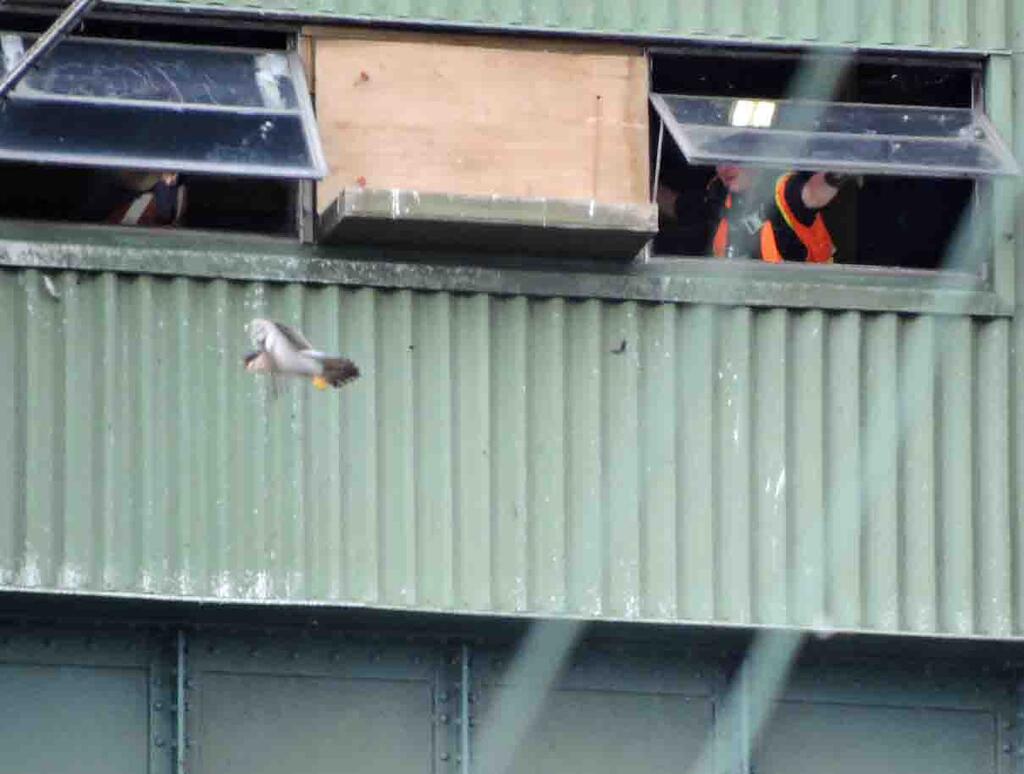
Maple, the smallest of the three, will take her first flight from the nest on June 20 at 5:04 p.m. I was ready with my camera and anticipating this event and it paid off. I did capture her nervous takeoff. It is quite a thrill to witness this event.
The two remaining sisters were very close, trying to out do each other, flying together talon touching and being the first to the food that mom was offering. Exploring this new open-space world was new to them as they made new discoveries together. Mom was not as successful at catching food as we were hoping and dad for the most part was a self-serving individual. Occasionally Cirrus would see him eating his catch and not intending on sharing, so she would move in and rob him of his catch in order to get what was left to the juveniles. There was an incident where we helped the seemingly overwhelmed Cirrus out, by scaring a pigeon out from its hiding place under a boat trailer at the marina, after Cirrus had hit it twice and knocked it to the ground. We saw where it was hiding and Cirrus was up on one of the skyway bridge support pillars and she was looking down for it and had lost sight of where it was hiding. Voila, we made it magically appear so that Cirrus could have a second attempt at it. It was a success, Cirrus saw it come from out of no where and she swooped down from the support pillar above us, to secure it this time right in front of us. Cirrus was eager to get it to the hungry juveniles.
On July 2 we observed dad arrive and land up on the cables that run across the canal between the two green towers, with something that he had just caught. I always look to see if I can identify what dad is catching and eating. This bird was medium size and bright green and yellow. An odd colour for an oriole and too big for a goldfinch. I zoomed my scope in closer to find out that it was in fact a Budgie. He did not share this with the others.
On July 8 our attention was drawn to Maple because she was not calling out for food, not flying much and sitting in locations that she had never been seen before. We were getting concerned about her. Her crop seemed really full, which was surprising for how little she was seen receiving food according to my records for the previous three days. We discussed the possible reason may be a blockage in the crop and not allowing the food to work its way down into her stomach. I stayed till after 9:00 that night to keep a watch on her. We were concerned and would keep a very close watch on her.
The next morning June 9, I arrive before 8:00 a.m., earlier than I ever have before. People who know me know that I usually arrive around the crack of noon. This was serious for me to start so early. I had intensions of possibly capturing Maple as soon as the opportunity arises, so I got the carrying cage and towels ready at the start of the day like we were trained to do, just if the moment presents itself, we would be ready and not be looking for any of the necessary equipment.
On this morning Maple was located on the corner of the control house roof, again not a normal location for her to be if she was doing well. I made a cell phone call to the Canadian Peregrine Foundation’s Mark Nash, and described Maple’s condition to him. Mark informed me that the bridge people had already been in contact with him as well. Mark described to me that Maple had one of two possible things going wrong with her. If the crop was blocked, that was treatable and not too serious. The other was very serious, a parasite contracted from the pigeons, results in a condition called “FROUNCE”. This was deadly serious and highly contagious to the other juvenile but not to the adults, as they have built up the antibodies to it. You might remember in 2007 at the Sheraton nest site, two of the chicks died in the nest from something, well this is what they died from and one of the other chicks showed signs of contracting it and was sent to Guelph for treatment and recovered and was returned to the nest. Could we be able to catch Maple early enough to be treated, or is it already too far advanced for Maple to recover from?
We have been watching her for days trying to push the stuff from her swollen crop, down into her stomach, Maple not knowing that it wasn’t food but polyps growing inside of her air passages. She had lost her ability to call out to mom in just the last two days and was now gasping for air. Maple managed to gather some strength and fly a short distance from the top of the bridge to the Burlington tower and noticing Cirrus at the skyway support pillar opposite her, flew over to her. Cirrus noticed that Maple had not been doing well the last few days and had not eaten recently, immediately took off to secure a meal for Maple. Cirrus got a pigeon instantly but took it to a support pillar across the canal from Maple. Maple hurried over to get to the long overdue dinner but was in a weakened state and was unable to stay at the height of the awaiting meal and hit the pillar about two feet too low. Maple struggled to stay airborne and flew low across the marina parking lot and landed on the roof of a car of young fishermen that were standing around their car at this time. Boy were they surprised!
When I saw Maple fail at that landing attempt, I saw this as the opportunity that we were hoping for. We immediately grabbed the towels, the cage and ran like hell to get to her. The men saw us all running in their direction and pointed to Maple standing on the roof and asked if this was our bird that we had lost ? I was too cautious and was not able to capture Maple from this car’s roof. As Maple was watching me approach and walking away from me, the wind came up Maple had her wings half out and the wind picked her up and off of the roof. Maple took off low to the ground and headed towards the canal and I felt that she would not have the strength to make it across to the other side. John and I were in hot pursuit of her. I lost sight of her as she veered behind one of the support pillars for the skyway bridge and landed on the back of the roof of another vehicle which was parked at the edge of the canal. This vehicle was occupied by two RCMP officers, while still running towards Maple, I shouted to them not to move or get out of their vehicle. I could see driver put his hands up to me through the window to acknowledge my request. He had watched Maple bearing down on them and us chasing her, in his rear view mirror and heard her land on their roof. We chuckled over that later. John was able to keep Maple’s attention trained on him while I approached her very close from a different angle and was able to gently toss a towel over her and secure her capture at last. Maple was placed into the carrying cage for her journey to the awaiting animal clinic.
We were all hoping that we had been able to capture Maple in time to save her, but we had seen how advanced this condition had gotten, but still we held out hopes. The next day we received the sad news that Maple had not survived through the night and would not be returning. We were shattered by the news. We had done all that we could at this point but it just didn’t seem to be enough.
We were now left with just one juvenile and we kept a close eye on Truss because of how contagious this is and how close the two siblings were, emotionally and physically. I had witnessed Truss’ interaction with Maple the day before the capture. Truss was walking slowly up to Maple with wings drooped, like she wanted to give her sister a hug. Then Truss would do these crazy quick changing head positions, like she was trying to get a response from Maple by amusing her and trying to cheer her up. I do believe that they notice when one of their family members is not doing well. You just have to pay close attention to their interactions. On the days following the capture Cirrus seemed to be bewildered about the disappearance of Maple.
The days go by and we don’t observe a lot of feeding to the remaining Truss. She tries to attempt some hunting on her own but is far from any success at this time. As far as we can tell Truss seems to be receiving meals in the a.m. and not much after that.
July 24 and Truss is not being seen in the area on a regular basis. We feel that we should get Truss’s picture on milk cartons and contact the falcon aid and report these parents.
We were spoiled with the great success that we feel that we had last year compared to this one. We all still hold out hopes for a better outcome next year, providing that the scheduled winter bridge repairs and painting do not disrupt the whole picture for the peregrines.
We have some very sad news to report regarding Maple’ situation. We have received news from the vet that Maple’s illness was too far advanced and that she has passed away during the night.
We would like to thank everyone that was involved in the rescue of Maple, and to all those that submitted your photos and observations, as it was most appreciated. They told a huge story. With the combined observations of her activity over the past days, it has been quite evident that Maple was very sick indeed.
As we suspected, based on the combined photo evidence and the visual observations of her overall body condition and behavior, we expected that her prognosis was not going to be good. Maple suffered from a number of challenges,,, in particular an avian ailment / illness called Trichomoniasis, commonly referred to as “Frounce or Tric” in raptors. It is this along with several other complications that lead to her death.
Avian trichomoniasis is principally a disease of young birds. The severity of the disease depends on the susceptibility of the bird and on the pathogenic potential of the strain of the parasite. Adult birds that and recover from the infection may still carry the parasite, but they are resistant to re-infection. These carriers do not show obvious signs of infection. Trichomoniasis is caused by contaminated food, in particular and likely in this case, from pigeons.
In young birds, the early lesions appear as small white to yellowish areas in the mouth cavity, especially the soft palate. The lesions consist of inflammation and ulceration of the mucosal surface, and increase in size and number and extend to the esophagus, crop and proventriculus. The lesions may develop into large, firm necrotic masses that may block the lumen. Occasionally, the disease may spread by penetrating the underlying tissues to involve the liver and other organs. Without a close examination of the subject, the lesions are often very difficult to detect in their early stages.
How to Know When Birds are Infected
In most cases, there may be little indication that the bird is infected, and death may occur quite suddenly. In other cases, infected raptors may stop feeding, lose weight, look ruffled and dull, and be unable to stand or maintain their balance for periods of time. Death may occur within a week of infection as the disease can spread very quickly. Milky white fluid or yellowish cheesy coloured material may accumulate in the mouth and crop, and this material may exude from the beak. A pendulous crop may develop.
How to Know if Birds are Infected with Trichomoniasis
Characteristic yellowish-white nodules in the oral cavity – (mouth), esophagus and crop strongly suggest trichomoniasis. The infection is confirmed by finding the organism during microscopic examination of the yellowish fluids, cheesy material or the lesions. By the time most birds start to exhibit signs of the illness, the infection has already taken a strong hold over the bird, and young birds with an already weakened immune system, they typically succumb to the affects of the illness.
Despite the end result, it was well worth everyone’s efforts and time spent for her both her rescue and to get her to the vet, as Frounce can be successfully treated with antibiotics and the bird can survive if caught / treated early enough. Sadly, there was no way of helping Maple until she came to the ground, as attempting to trap her in this environment, (with the addition of two attending parents) was not an option. Sadly, by the time that her condition was recognized, (given the advanced stage of her illness), it was too late for antibiotics to effectively deal with the illness.
With a huge thank you to all who were involved in bringing Maple’s situation to our attention, as the calls started approx. 6:30 am this morning alerting us that something was not well with one of the young fledglings. The bridge staff reported that a young peregrine had come down to the lower hand rail on the lift portion of the bridge - (only several feet away from the passing traffic), and that it was unable to gain any altitude over the corse of several short and very weak flights.
By 7:15 am, the first photos arrived via e-mail, and despite that they may have appeared to simply look like a normal sleepy bird, they told a quite a different story. The fledgling juvenile was identified as Maple, and with the combined observation reports of her activity this morning, it is quite evident that Maple is very sick and in need of emergency medical attention.
The morning was filled with numerous calls and conversations with the avian vet, OMNR, the bridge staff, Sue and to Bruce who were all advised of the situation in anticipation that sooner or later Maple would be coming to the ground and the need to get her to emergency medical attention would be necessary.
Later this morning, Barry called and confirmed our worst fears as he described his observations of Maple’s activities and behavior over the previous two days. These observations combined with the earlier photos submitted of Maple pointed to a very sick bird indeed, with a suspected avian illness called Trichomoniasis, commonly referred to as Frounce or Tric in raptors. While this type of illness can be successfully treated with antibiotics, it requires that early diagnosis be made and that treatment be administered as soon as possible. Bruce was dispatched and arrived on scene at the bridge less than fifteen minutes before Maple came to the ground. A huge thank you to Bill and Sue, Barry, the Burlington bridge staff and all that were on hand and involved in the co-ordination and rescue of Maple!
Maple was quickly scooped up and placed in a rescue carrier and on route to the avian vet. She was admitted right away upon her arrival.
We will have to wait for the news on her condition.
Bill arrived at the bridge around 8:30am and was greeted by Barry who was already on site.Over the last couple of days, Barry had noticed that Maple did not appear well.She had a very large crop and was refusing food from Cirrus.You could see her trying to vocalize, but there was no sound.The Bridge Workers advised them that Maple was sitting on top of the Control Tower.After three attempts of walking and flopping her wings, she managed to get to the top of the bridge where she remained until approximately 3:00 pm.We watched her and she appeared disheveled and slept most of the time.She made a feeble flight and landed on the top rail of the bridge on the lake side and then again to the Burlington Tower.She spotted Cirrus at the Play Pen and managed a flight to her with a difficult landing.Cirrus shortly thereafter appeared with a meal which she took the bridge abutment above the boat parking lot.Maple, tried to follow but could not gain the height she needed and came to the ground landing on a parked car of some fishermen.An attempt was made to pick her up but she took off again, heading for the canal and this time landed on top of another vehicle that was parked by the canal.This time the rescue was successful by John and Barry and Bill with the rescue box.She was wrapped in a towel and immediately transported to the Toronto Wildlife Centre by Bruce Massey.Bruce had arrived about 10 minutes before the whole melee started.We are grateful that Bruce was on site so that we didn’t have to wait for him to get through Toronto QEW traffic.We are anxiously waiting to hear about “our” girl.Thanks to everyone who was involved in the rescue.Boy, Falcon Watching can sure be stressful.
Between storms today, Bill and I decided to make another trip to the Lift Bridge.We arrived just around 6:00 pm.Barry had stuck it out through the storms and was able to point out where the juvies were hanging out.In a flash, Sir appeared carrying dinner in his talons.He took it to a picnic table to prepare.Maple and Truss watched in the hopes that he would share.We jumped onto the scopes and low and behold, Sir had delivered a Budgerigar.Unfortunately, another downpour started and we didn’t actually see who got the bird, but we are pretty sure that Sir did not share.We sure hope that the owner didn’t witness the wrath of Sir as he swept in and grabbed the family pet.
Throughout the downpour, Truss and Maple remained on the wires.They were just like drowned rats.
Things are pretty quiet at the Lift Bridge.It would appear that the girls are trying to stay cool as for most of the day, no one was visible.No one on the Hydro Tower, no one under the Skyway and no one on the face of either tower.Finally, early this afternoon there was some flying back and forth between the two towers and then all went quiet again.After our dinner break, we found Cirrus sitting quietly under the Skyway.All of a sudden both girls joined her.This was the first time that we have seen them make that trip.There was lots of vocalizing for Cirrus’ attention.The funniest part of all this was that Cirrus was sitting about 2 feet away from 3 pigeons, who were keeping an eye on her.As we left this evening, Sir had finally appeared and was having a nap on a ledge on the Burlington Tower, with Truss above him and Maple below him.Cirrus had gone on a mission towards Burlington.
Just one of the many days at the Burlington Lift Bridge with all hands present, (and this day actually had some sun included)! While very organized, there were many eyes to the sky documenting almost every minute of the young peregrines activity. I must say that these little peregrines must be the most photographed stars in southern Ontario!
A small collection of some of the incredible folks that came out to help and stand by their peregrines!