May 18, 2023 - Hamilton - Sheraton Hotel
Marion Nash Reports:
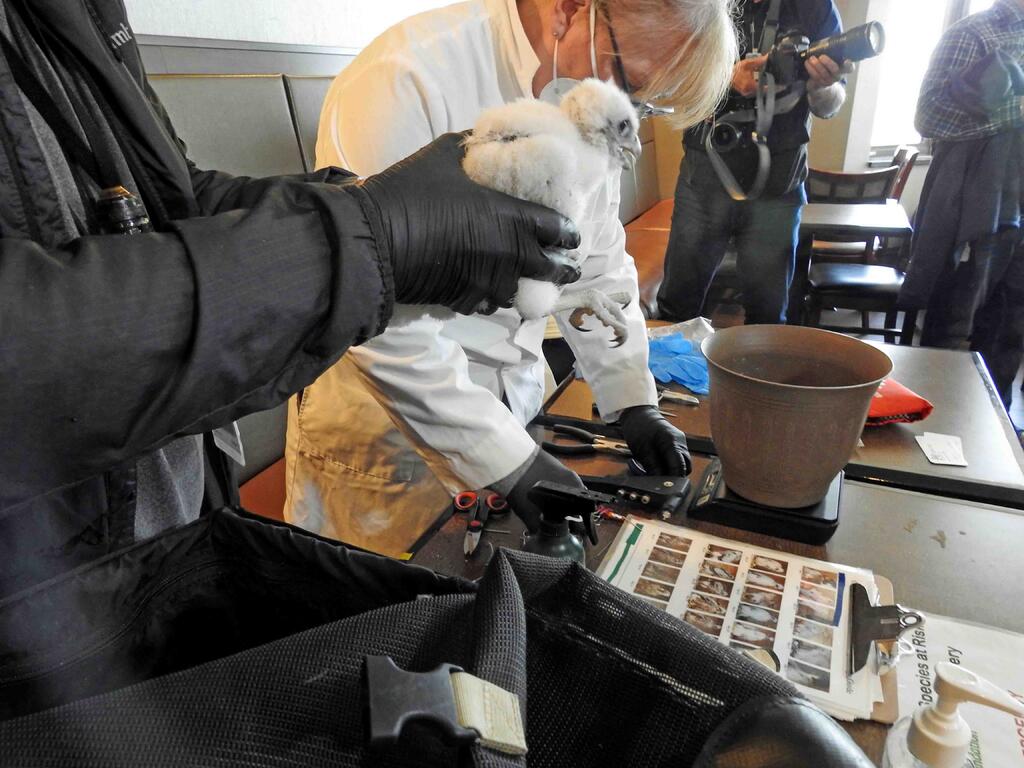
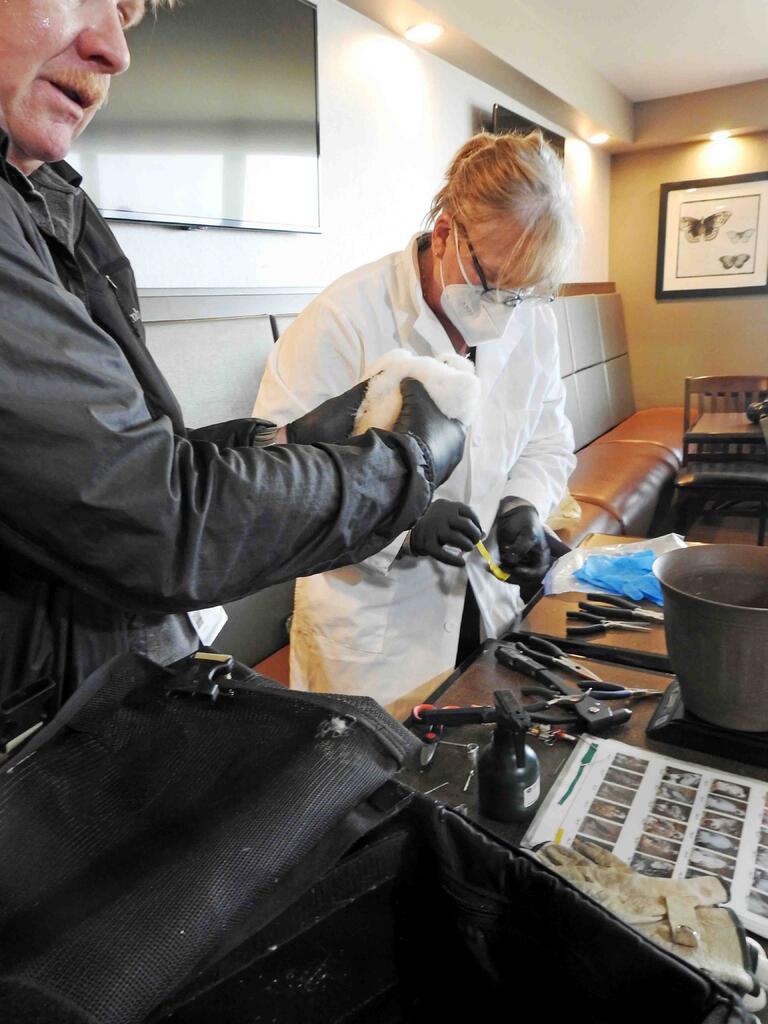
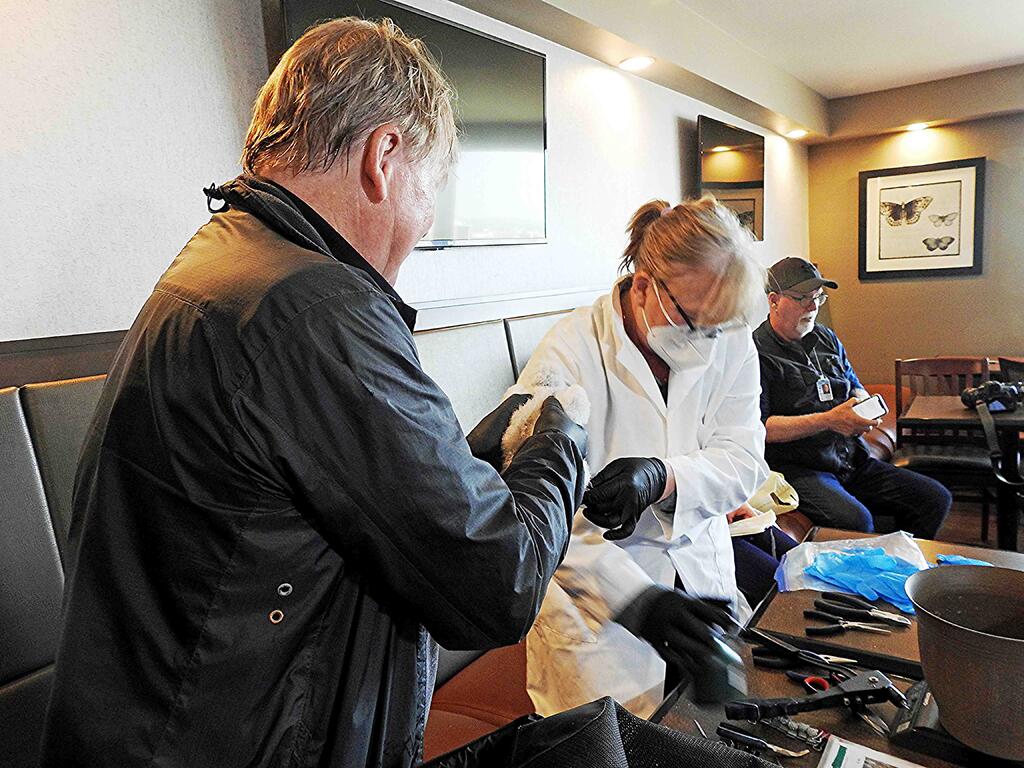
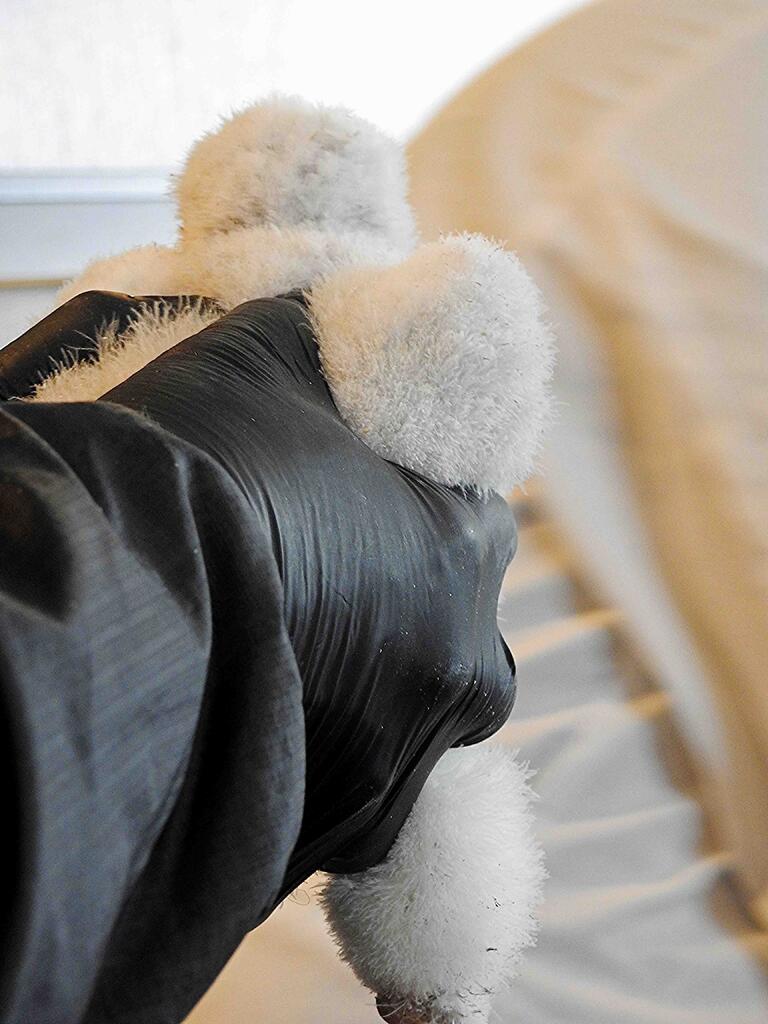
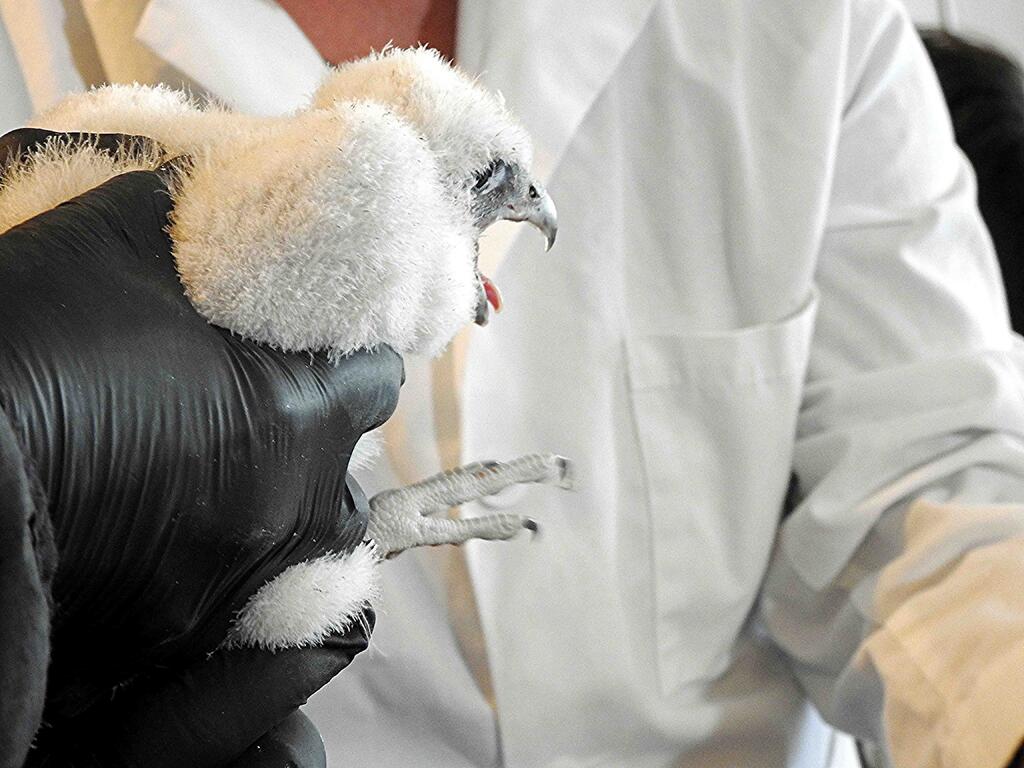
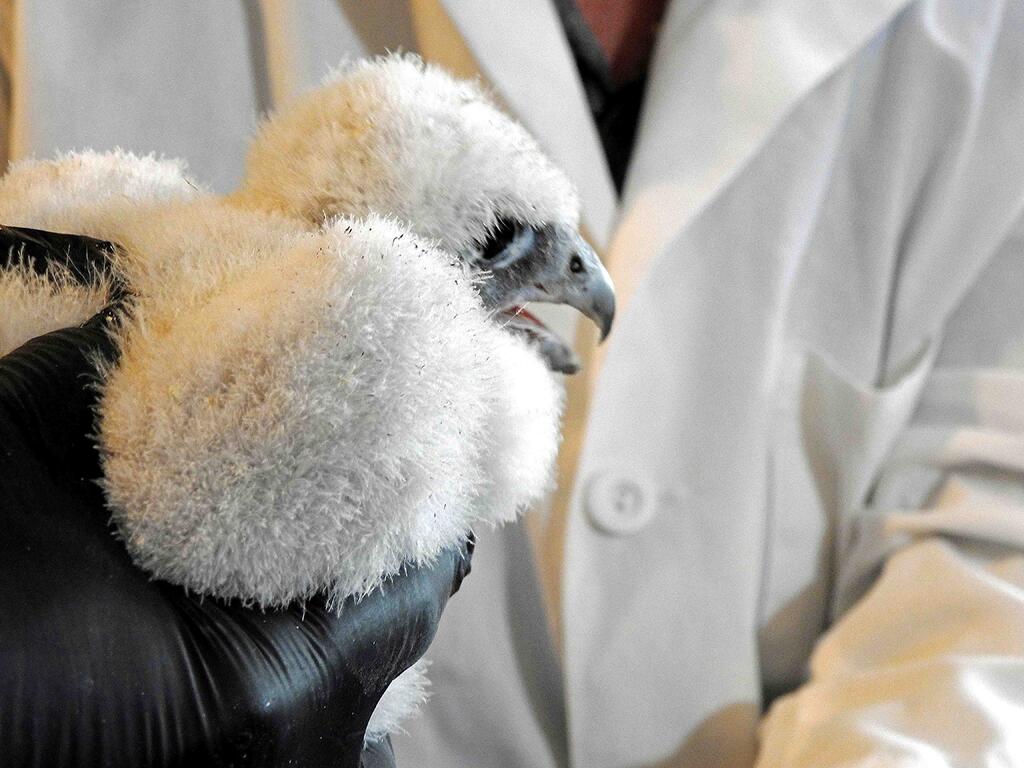
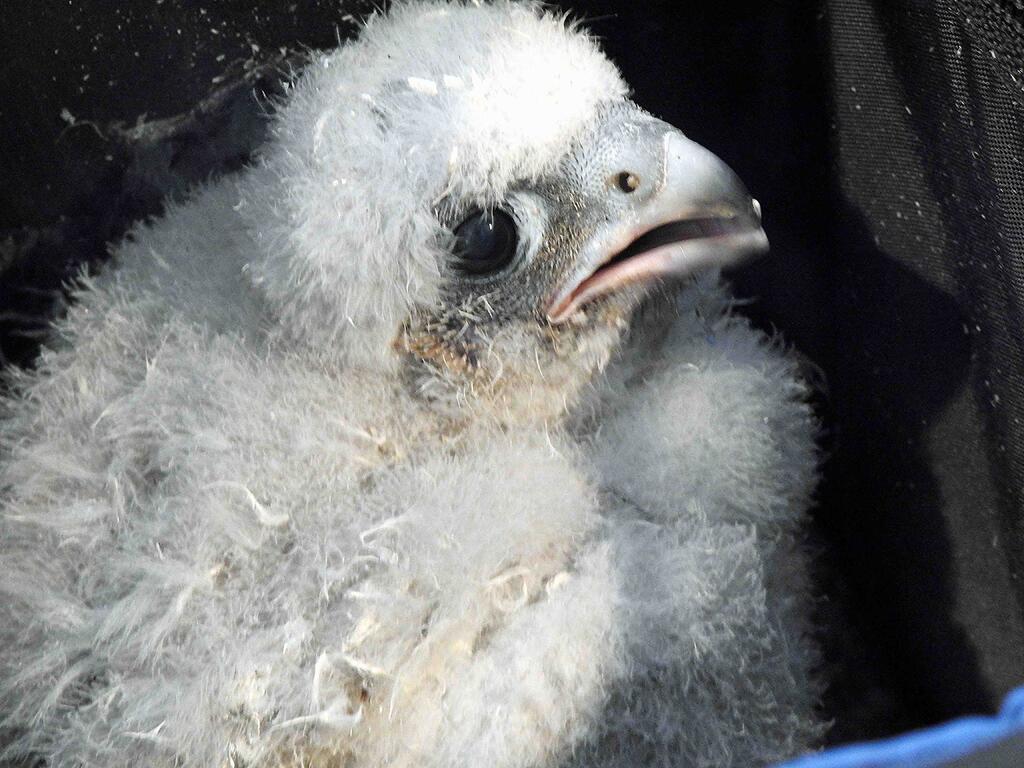
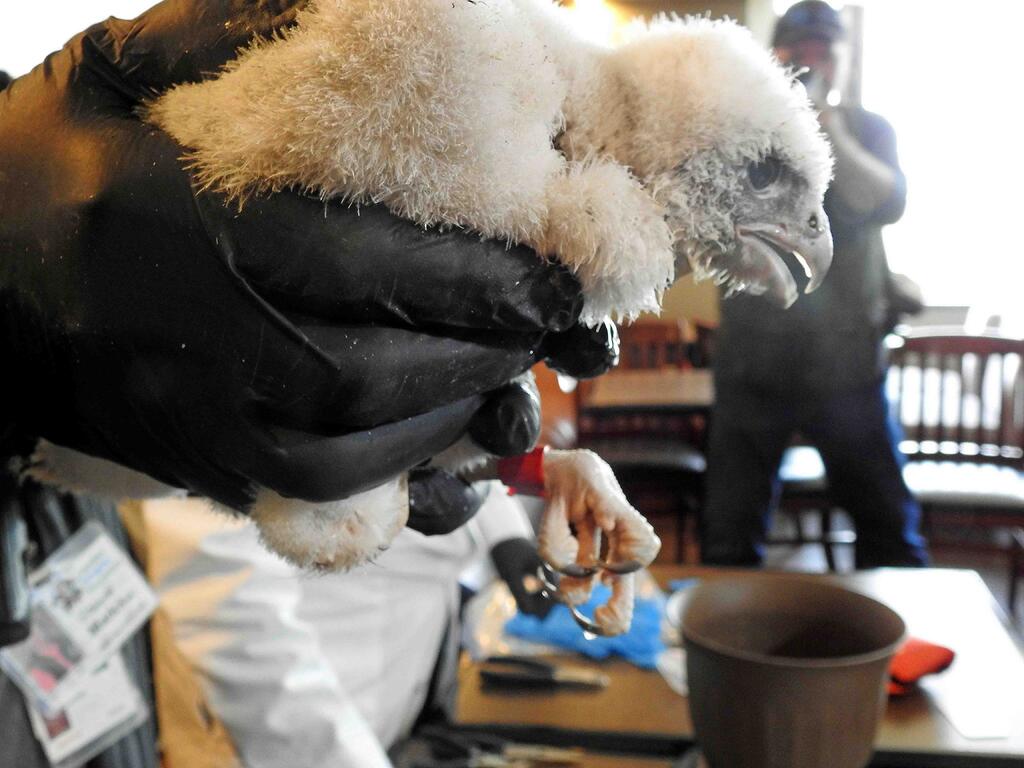
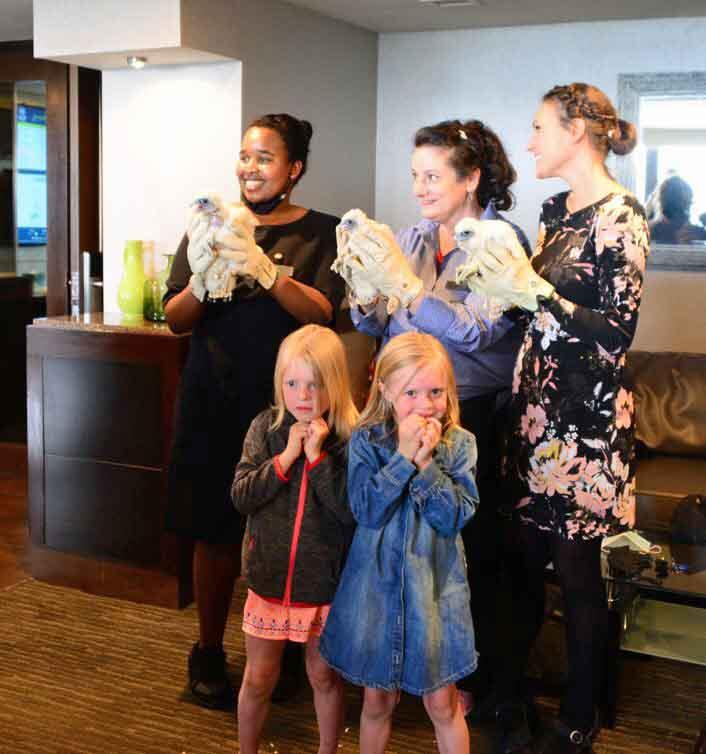
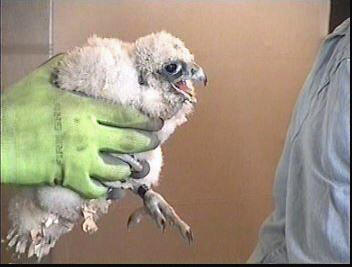
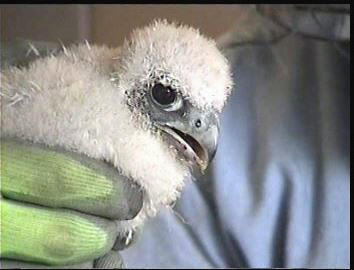
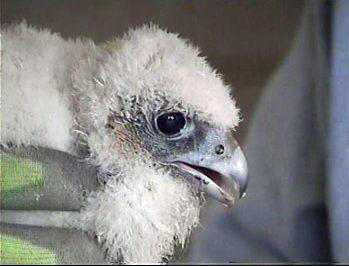
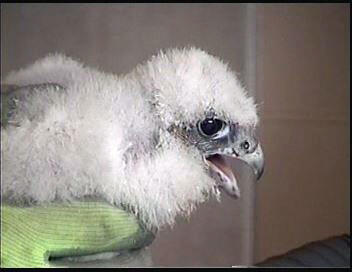
Great day to band the chicks. All 4 chicks were in good health no signs of Avian Flu or any other illness. there were 3 boys and 1 girl.
The Hamilton team chose names of Hamilton communities for their chicks the female named Delta immediately got the nickname of Delta Dawn;)
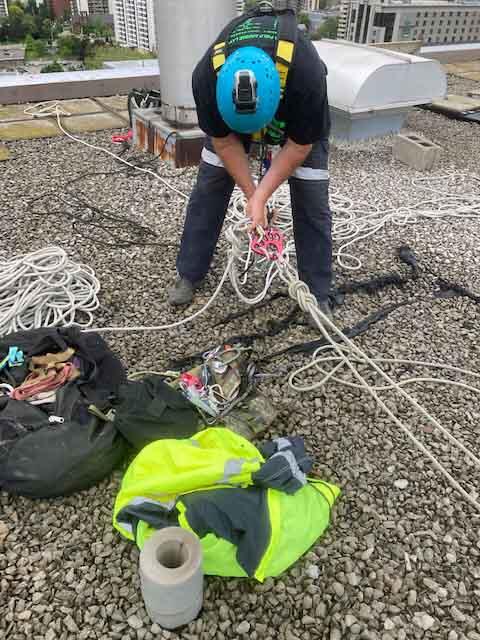
There were 2 new climbers this year Jesse and Ryan who did a great job extracting the chicks for their first banding day climb and extraction 2 very keen and brave lads. A big thank you to both of them.
The Hamilton Fledgwatch team as always had everything ready for an efficient, safe and successful banding and we are so grateful to them for continuing to support the banding of Hamilton’s Peregrine chicks a job well done.
Thanks goes out to the Hamilton Sheraton Hotel for being such a wonderful and supportive host!
We wish the Fledwatchers the best of luck for 2023.
Here are the names and weights of each chick.
Kirkendall male 592 grams
Gibson male 570 grams
Delta female 753 grams
Stipley 577 grams.
The chicks were younger at banding this year 18 and 19 days old so the weights were lighter than they would have been at the usual age of banding in Hamilton of 21 to 23 days.
Posted on May 18, 2023 8:31 pm
May 03, 2023 - Hamilton - Sheraton Hotel
Marion Nash Reports:
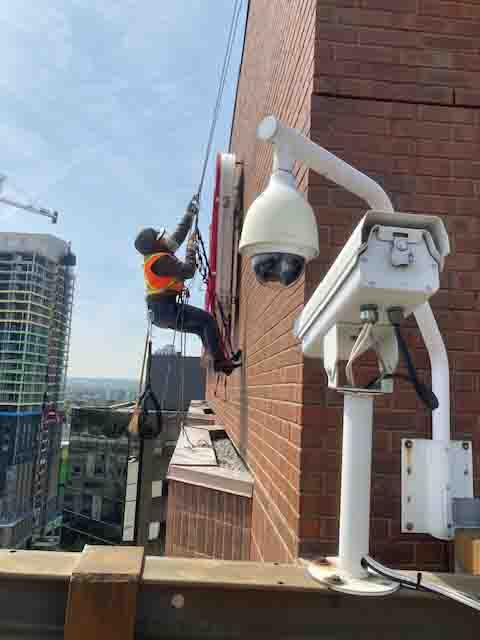
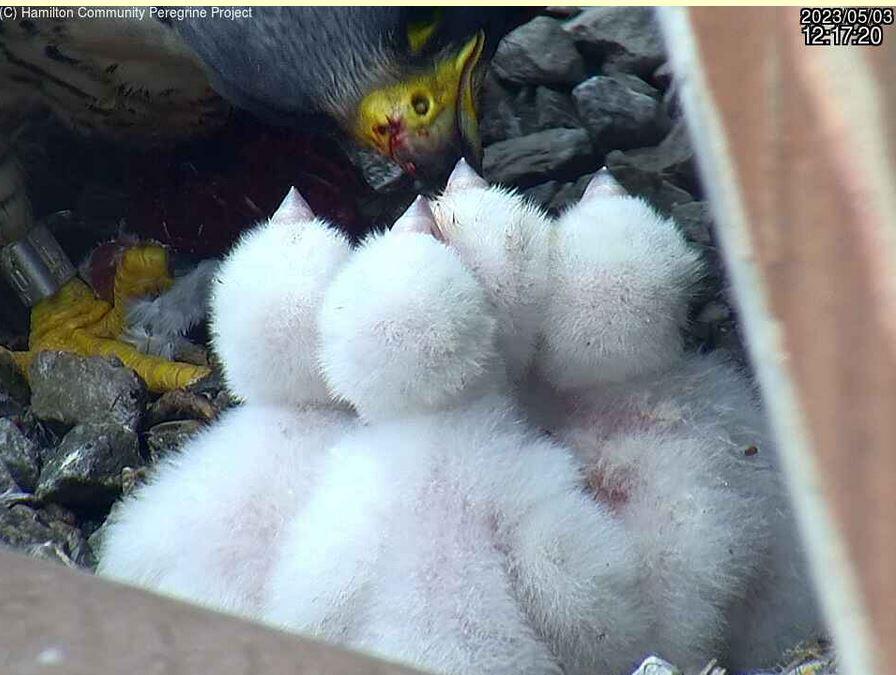
The Hamilton 4 are being fed May 3rd. We have booked the Banding of the chicks for May 18th at 1:00 PM. It will be a first chick extraction for our new climber John Beals but not his first time at a peregrine nest. John a window washer has had to deal with peregrines at several sights in the GTA.
You can watch the web camera on banding day at http://falcons.hamiltonnature.org/?wide
Stay tuned for banding information and photos.
Posted on May 3, 2023 1:19 pm
May 01, 2023 - Hamilton - Sheraton Hotel
Marion Nash Reports:
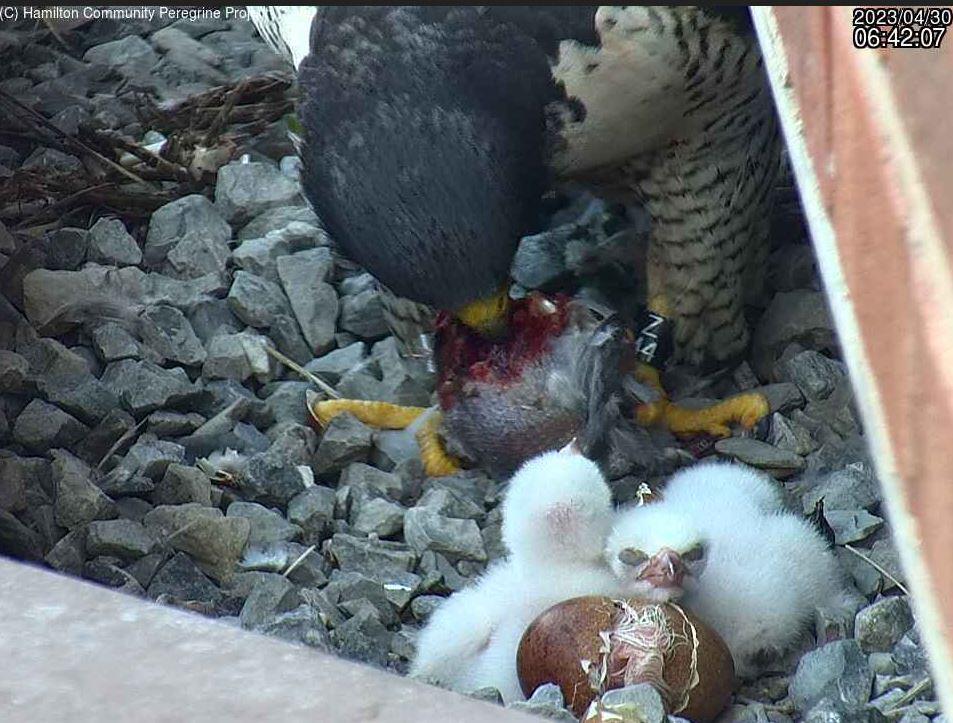
Sunday, April 30, 2023 - Early this morning, McKeever flew in to feed her chicks, and we saw that there was now a third chick eagerly clamoring for food. As we watched the chicks get fed, we began to see the egg in the foreground crack apart, and, over the next half hour, our fourth and final peregrine chick hatched. As is usual, It had a little help from mom, who picked away the edges of the shell. You can see a piece of shell in McKeever’s beak in the last photo.
A month ago we mentioned how the adults carefully timed the incubation of the first eggs so that they would all hatch together, and this has now resulted in all four eggs hatching within 24 hours! With four in the nest, we will see a lot of feedings over the coming month. And needless to say, we’re going to need a lot of volunteer watchers. If you have some time to spare in June, please click the Volunteer button at the top of this page. Thanks!
TWO CHICKS SO FAR
Saturday, April 29, 2023 - Just beore 6pm, we caught our first sight of two new peregrine chicks in the Sheraton Hamilton nest. Their white down feathers were already dry, so it seemed likely that they hatched several hours before, while their mother kept them sheltered from the rain. Feeding began almost immediately (photos). We should see the other two eggs hatch within the next day or so.
HATCHING IS STARTING!
Saturday, April 29, 2023, 2pm - Just after 8am this morning we noticed the first tiny hole in one egg, then soon saw a crack appearing in another. We knew this was coming as McKeever fussed over the eggs in the last day, listening to the tiny sounds of chicks inside the eggs. She will continue to move and turn the eggs, which helps the chicks peck their way out of their shells. By this evening we expect to see the first little white balls of fluff.
Posted on May 1, 2023 5:39 pm
March 28, 2023 - Hamilton - Sheraton Hotel
Marion Nash Reports:
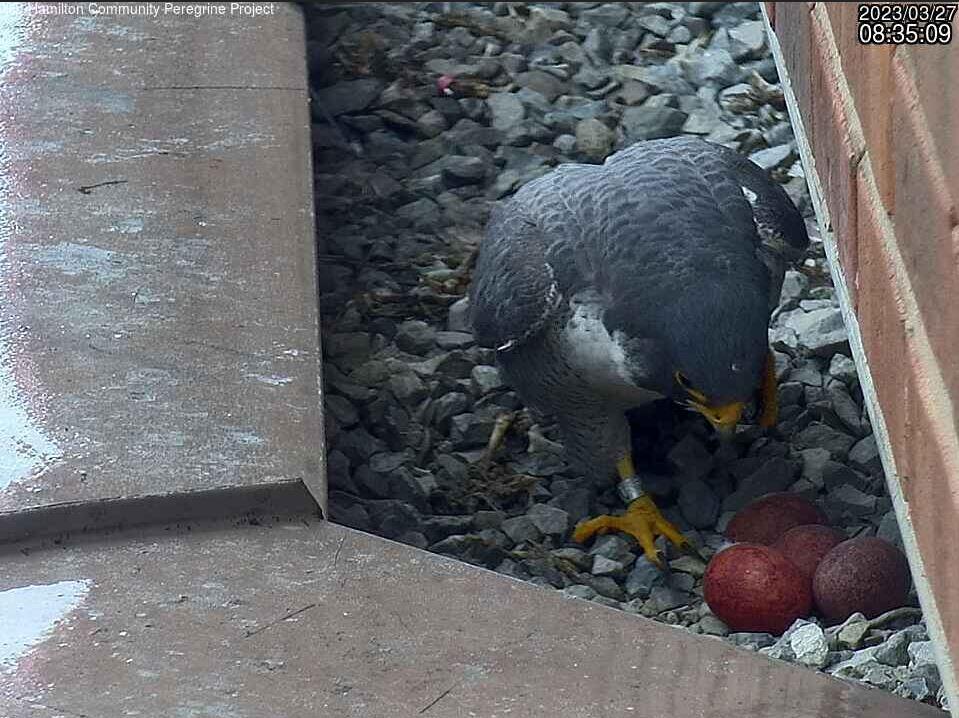
This morning McKeever laid her fourth egg of the season, with our camera catching a great view as it happened. A half hour later, Judson came in to take over incubation duties from her, and we got a clear look at all four eggs. You can see the color differences between the new egg and the older ones, which have picked up a coating of dust. It is possible that McKeever may lay one more egg. We have had five eggs before, but we have never had all five hatch. So, with good weather and close attention from McKeever and Judson, we have high hopes for seeing four tiny peregrine chicks at the beginning of May.
Posted on March 30, 2023 2:00 pm
June 28, 2022 - Hamilton - Sheraton Hotel
Marion Nash Reports:
for more observations log into http://falcons.hamiltonnature.org/?wide
COOLER DAY, MORE FLIGHTS
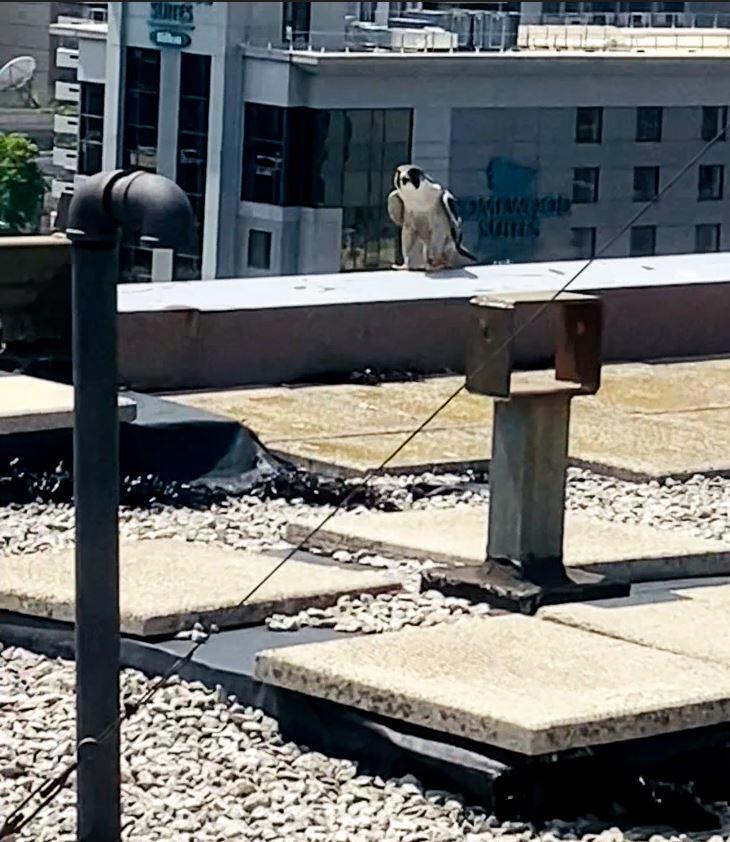
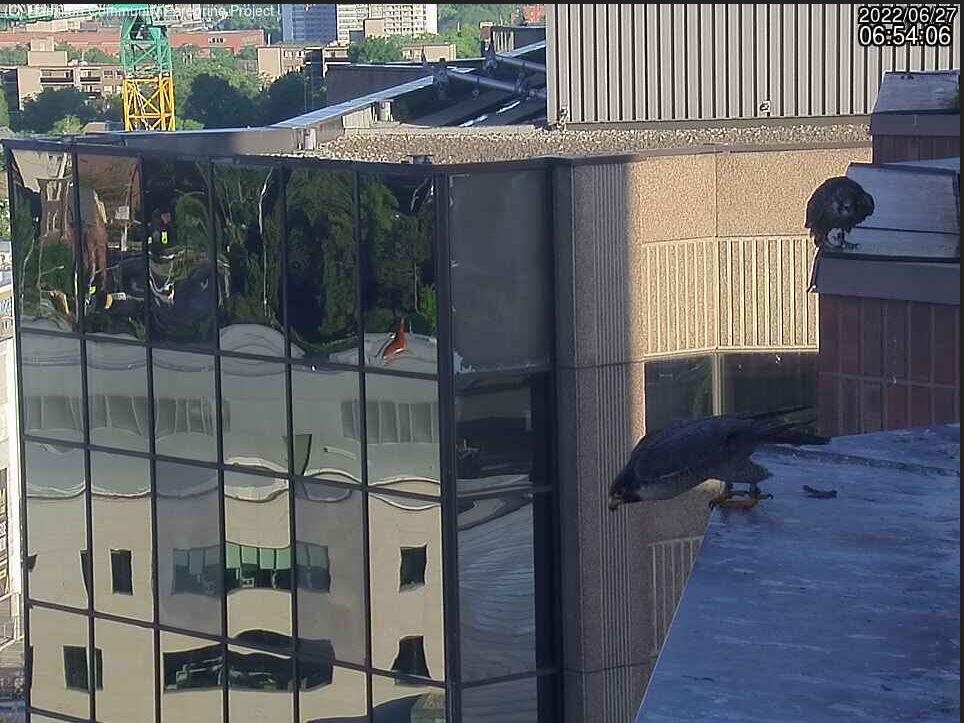
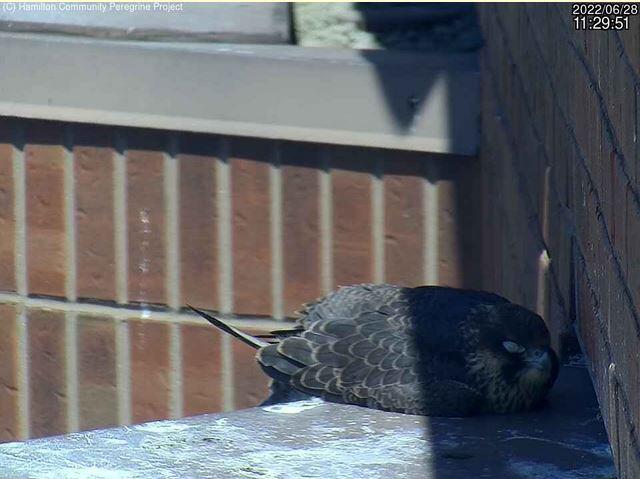
Monday, June 27, 2022 - Falconwatch Coordinator Marzuk Gazi reports: For most of the morning, the chicks were seen on the roof of the BDC building, as well as Fairclough, Stelco tower and Standard Life, spending very little time on the Sheraton. An adult landed on the nest ledge at 6:54, and a chick landed on the next ledge over. Within seconds, they both took off again (photo). The chicks were seen flying impressively during the morning and afternoon, two of them often practicing their talon touching and playing tag with each other in the sky, while a third lagged behind. By 1:55, all of the chicks had been spotted, three on the north facing edge of the BDC roof and the last one still on Homewood. There were a couple of feedings, with one at 3:10 on the east side of the roof of Standard Life in which Mckeever was seen helping her chick eat and then finishing the scraps herself.
The impressive flights from the chicks did not stop. They were seen spending a long time in the air, sometimes circling above downtown, and other times chasing each other closely and continuing to practice their talon touching. A chick, thought to be Auchmar, spent most of the evening on the Northeast corner of the Standard Life building, not joining in with most of the flights. By 7:00 the chicks had all moved over to Standard Life. At 8:30, two chicks took off, and landed atop the crane being used on the construction site to the southwest of Standard Life. They then flew off to BDC. At the end of our watch for the day, all four chicks were on BDC, with a parent watching over them from the Southwest corner of the Fairclough roof
Posted on June 28, 2022 11:37 am
May 27, 2022 - Hamilton - Sheraton Hotel
Marion Nash Reports:
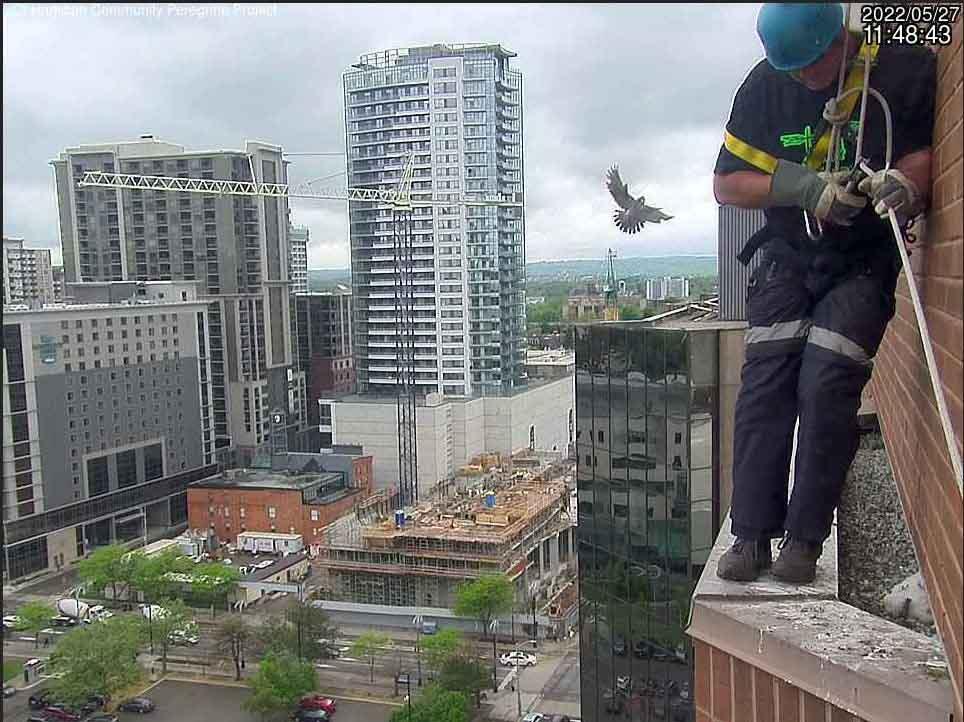
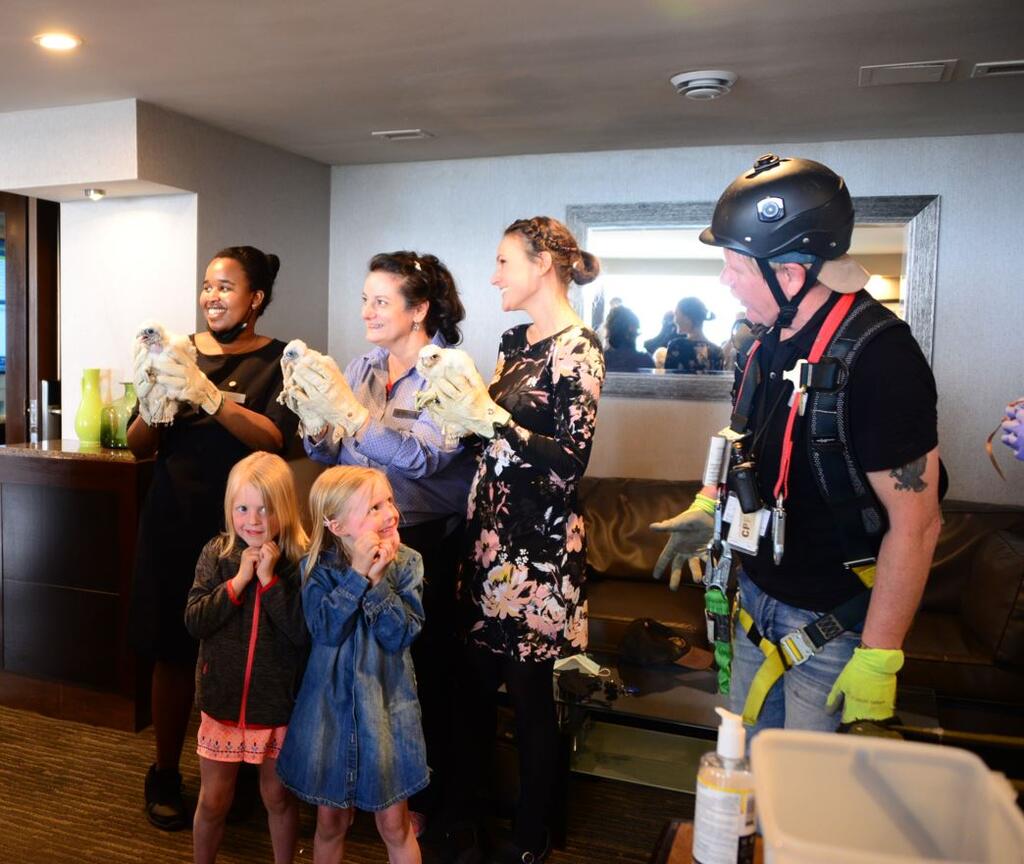
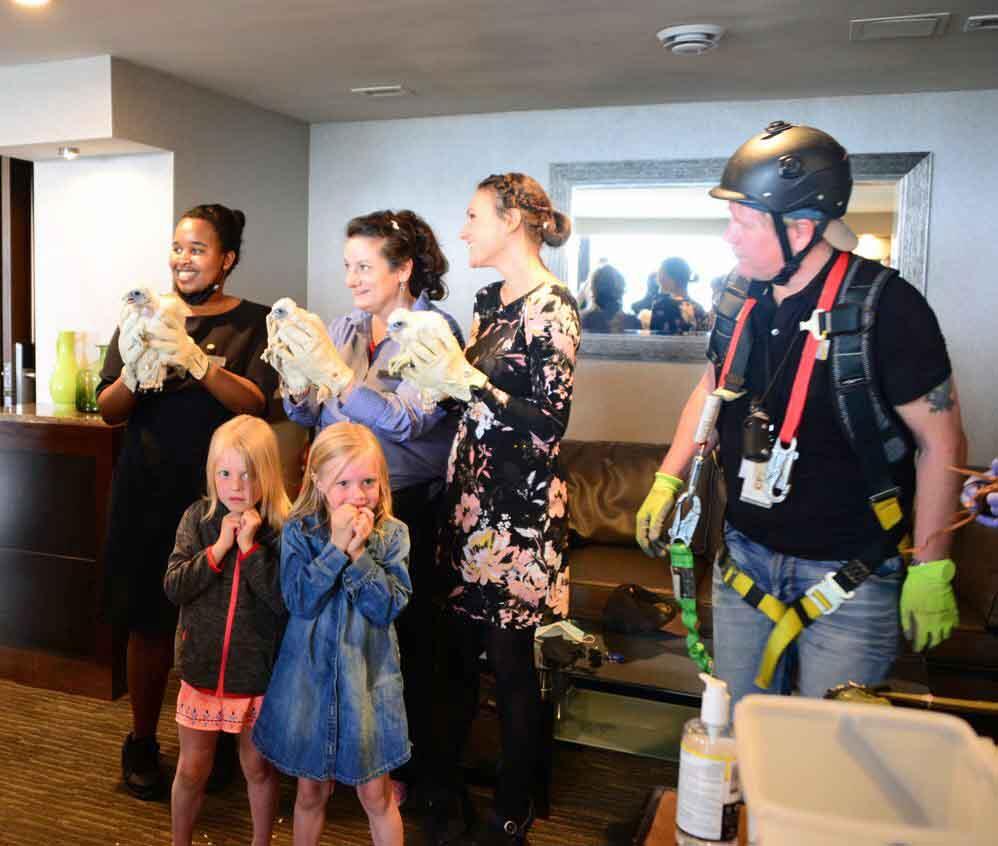
The Hamilton Fledge watch Team and The Canadian Peregrine Foundation volunteer banding team wish to thank the staff and management of the Hamilton Sheraton Hotel once again for their warm welcome and providing their lounge on the 17 floor to band the falcon chicks.
At noon John Miller CPF volunteer did the climb down to collect the chicks and keep McKeever the adult female busy during the banding. KcKeever was produced at the Windsor Ambassador Bridge in 2019 and was given her name at banding by Marion Nash of CPF in honor of Kay McKeever of the Owl Foundation who have for many years assisted in the rehabilitation of several injured fledglings produced at many Ontario urban nest sites.. John also pulled the plant out of the nest so the camera view will be much better in the spring when looking for eggs and McKeever and her chicks will have no sticks in their way.
There were a great mix of 2 boys and 2 girls all of good weight and all healthy.
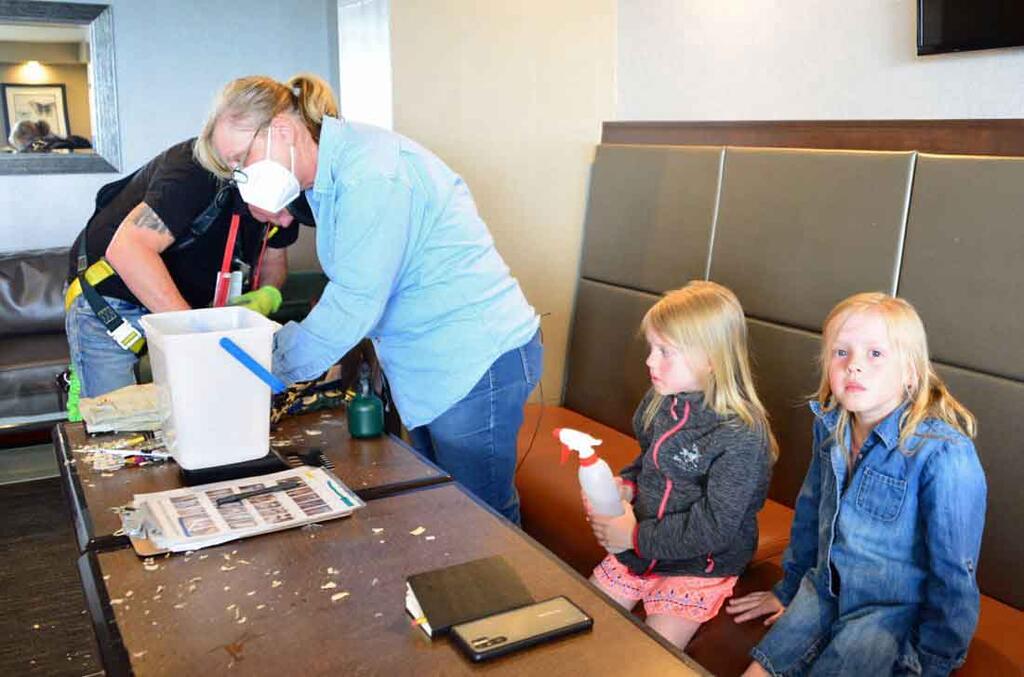
John brought his lovely twin granddaughters Celeste and Amelia to help at the banding table. One gave each chick a drink of water while it was being banded and the other assisted in putting on the colored tape on the silver band used to help the fledge watchers identify the chicks from a distance when they take their first flights. Thank you Celeste and Amelia!
Here is the banding information for each chick. Names were provided by the Hamilton Fledge Watch Team. Photos provided by CPF and Hamilton Nature.
834 grams female band number H over 70 with green tape named Wynnstay
663 grams male band number 30 over AW with blue tape named Balfour
781 grams female band number H over 71 with Yellow tape named Auchmar
612 grams male band number H over 72 with red tape named Dundurn
Fledge watch will begin soon and the Hamilton fledge watch team are looking for local volunteers.
You can see more information and video of the banding on this link http://falcons.hamiltonnature.org/?wide
Posted on May 28, 2022 12:17 pm
May 16, 2022 - Hamilton - Sheraton Hotel
Marion Nash Reports:
Mississauga MEC May 17th 11:00.
Canada Square May 17th 2:30.
Etobicoke Private Residence May 24th 10:30.
Bloor Islington Place Etobicoke May 24th 2:30.
Port Colborne May 25th 10:30 AM
220 Duncan Mill Rd. May 26th 10:30.
Hamilton Sheraton May 27 11:00 AM
St Marys Cement St Marys Ont May 30th 1:00 Pending
Lake Ridge Health Oshawa May 31st 1:00 PM.
Kitchener CTV tower June 1st 1:00 PM
Waiting on hatch reports for
150 Ferrand Dr. Don Mills and Eglinton.
Yellow Pages Scarborough
Toronto Downtown Sheraton
Beachville quarry
Windsor Ambassador Bridge
Posted on May 16, 2022 6:36 pm
May 08, 2022 - Hamilton - Sheraton Hotel
Marion Nash Reports:
HATCHING!
First Chick of 2022 Second egg cracking
Proud momma with her three (so far) chicks
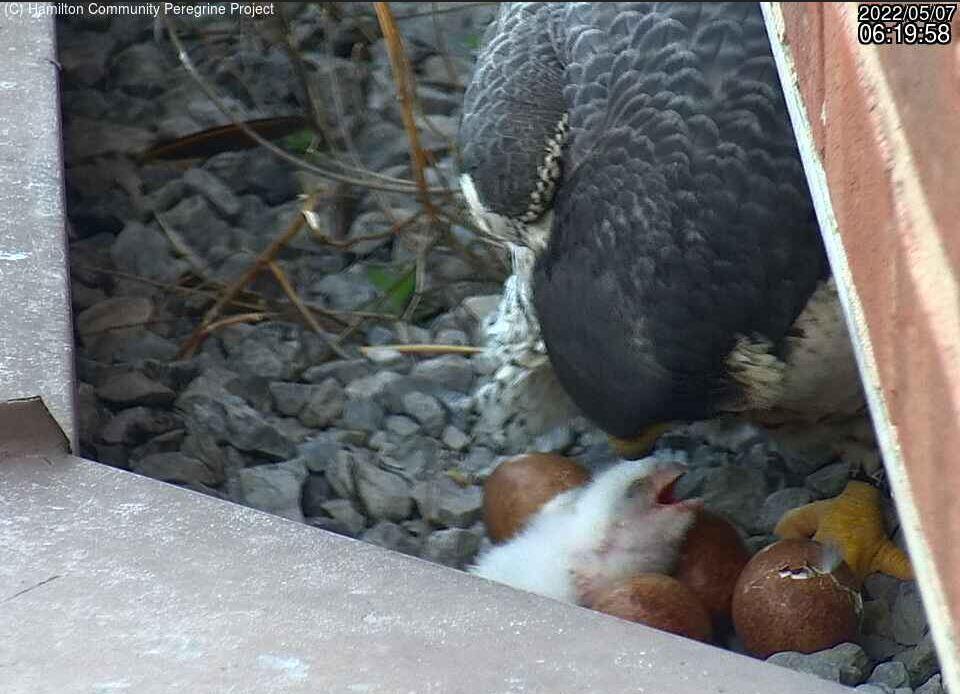
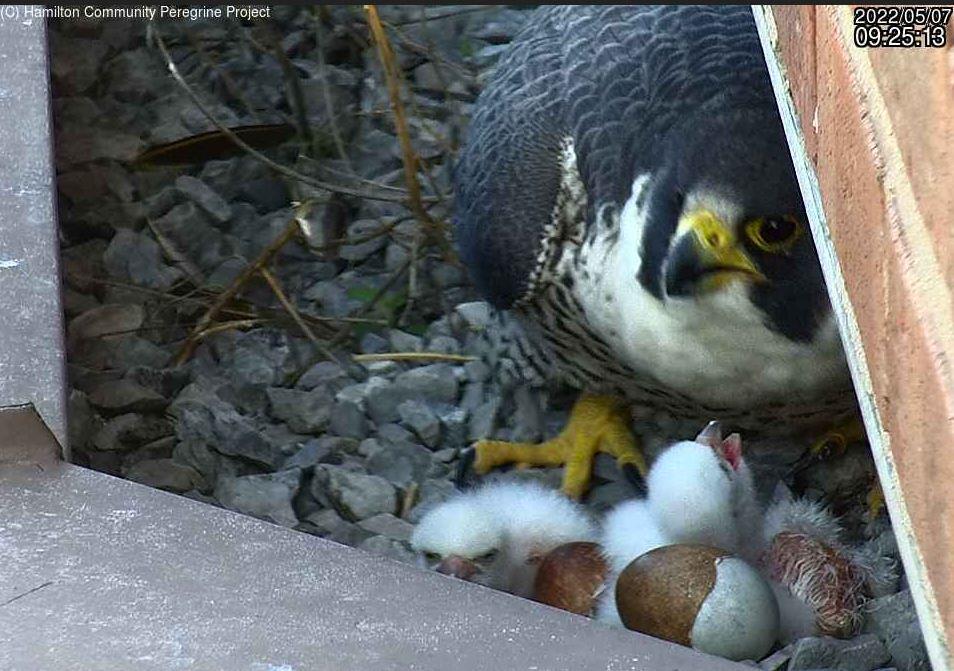
Saturday, May 7, 2022 - Hamilton has chicks! The first one started to crack through it’s shell yesterday, and finally hatched sometime last night. It was looking healthy and strong when we captured a photo of it at daybreak (left photo). You can see another shell cracking in that photo. Over the next three hours we captured some of the best photos we have ever captured of chicks hatching, emerging all pink and damp, and quickly drying off and turning white and fluffy.
Within the last couple of days we finally got a view of four brown eggs, but we still don’t know for sure if there is a fifth, or how many more will hatch. At this time it appears that a large piece of shell has wrapped itself around the old white egg, giving the appearance of a two-tone egg (right photo) which can fool us into thinking its a fifth brown egg, so we can’t be sure. But we won’t be surprised if another chick appears within the next day. Exciting times!
Hamilton Falconwatch News Updates
provided by the Hamilton Naturalists’ Club
Click an image to view full size in a new window.
FOUR LITTLE BEAKS
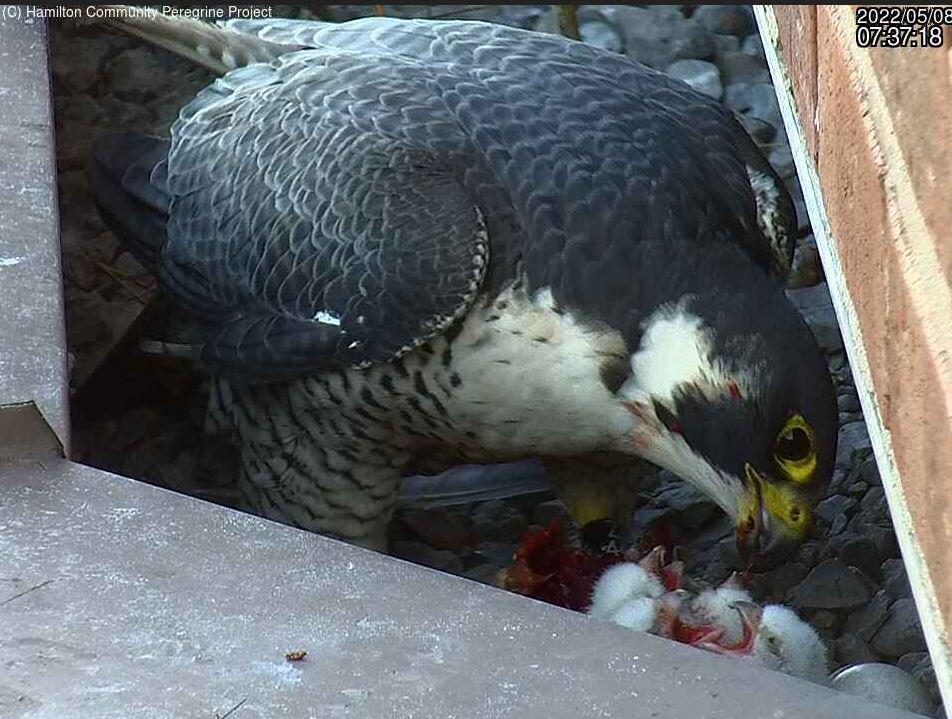
Sunday, May 8, 2022 - This morning we awoke to this sight of four chicks, hungrily clamoring for food. After a bit of trial and error yesterday, McKeever figured out the perfect size of morsel to feed her young. A sight we will see many, many times in the coming days. In case it isn’t already obvious, we’re going to need lots of volunteers to keep an eye on all these chicks as they fly around the downtown area in June and July.
Posted on May 9, 2022 9:13 am
April 06, 2022 - Hamilton - Sheraton Hotel
Marion Nash Reports:
Hamilton Falconwatch News Updates
provided by the Hamilton Naturalists’ Club
HAS MCKEEVER FINISHED LAYING?
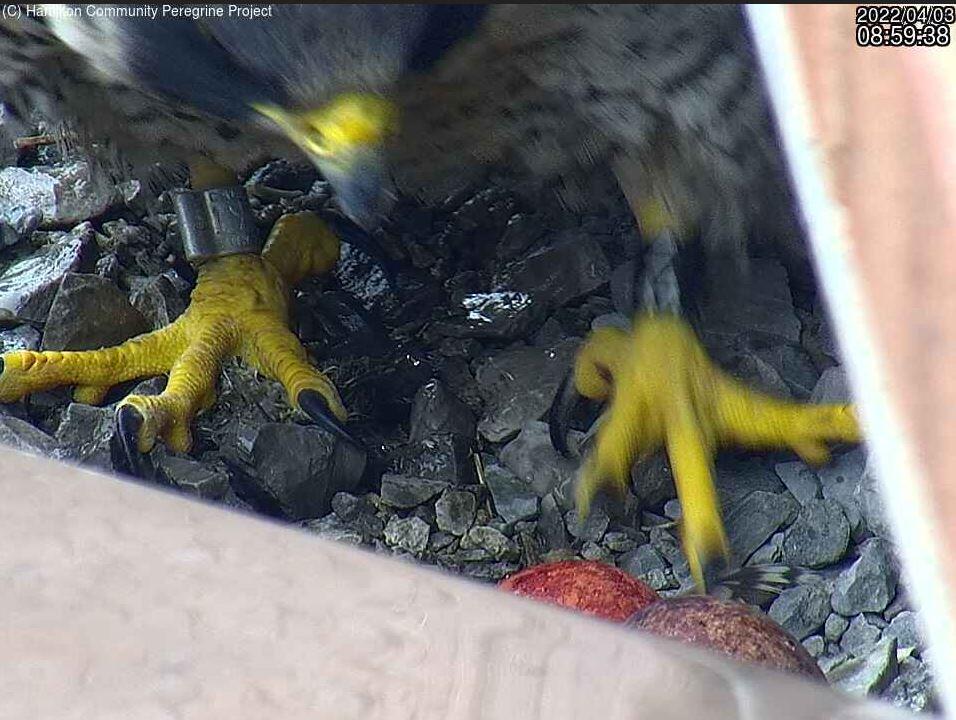
Sunday, April 3, 2022 - It was a week ago today that McKeever laid her first egg. Without being able to count them, we have two ways to estimate when McKeever has finished her laying. The first is a simple bit of math. Peregrines generally lay no more than 4 eggs, so, with an average time between individual eggs of about 2 days, the longest laying can last is about a week. On rare occasions, a fifth egg will be produced, which would make tomorrow the last day of laying.
Our other clue is to look at the color of the eggs. A freshly laid egg is much redder than one that has been sitting in the nest for a few days. This photo shows the difference quite clearly. The egg on the left has been laid more recently, while the one on the right has faded enough that we can be quite sure it is the first (or possibly the second) egg laid. Now, the waiting game begins. And in about a month we will see how many of these eggs are viable and actually hatch. With luck, and the youthful vigor of our two adults, we may see a very full nest this year!
Posted on April 6, 2022 12:34 pm
May 15, 2021 - Hamilton - Sheraton Hotel
Marion Nash Reports:
Hamilton Falcon Watch team reports
Saturday, May 15, 2021 - It has been a week since we should have seen our first chick, and it appears that Lily has accepted the fact that these eggs are not going to hatch. As the week progressed, she spent less and less time on the nest, and in the last 24 hours she hasn’t been on the eggs more than a few minutes. She has also been seen poking around the far end of the nest ledge, which is typical behavior for after nesting season.
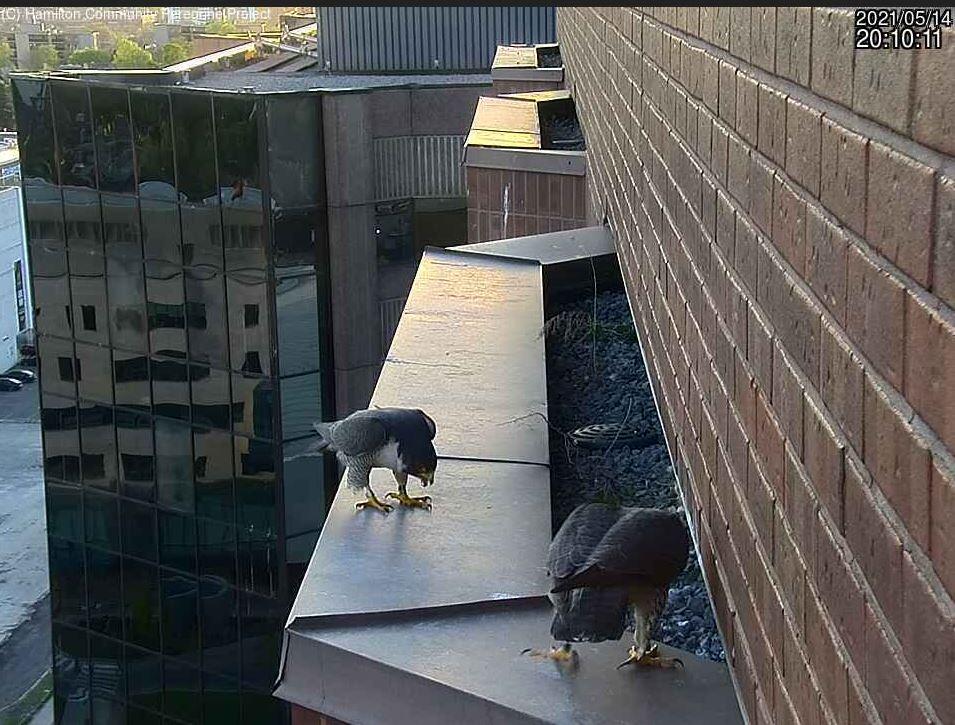
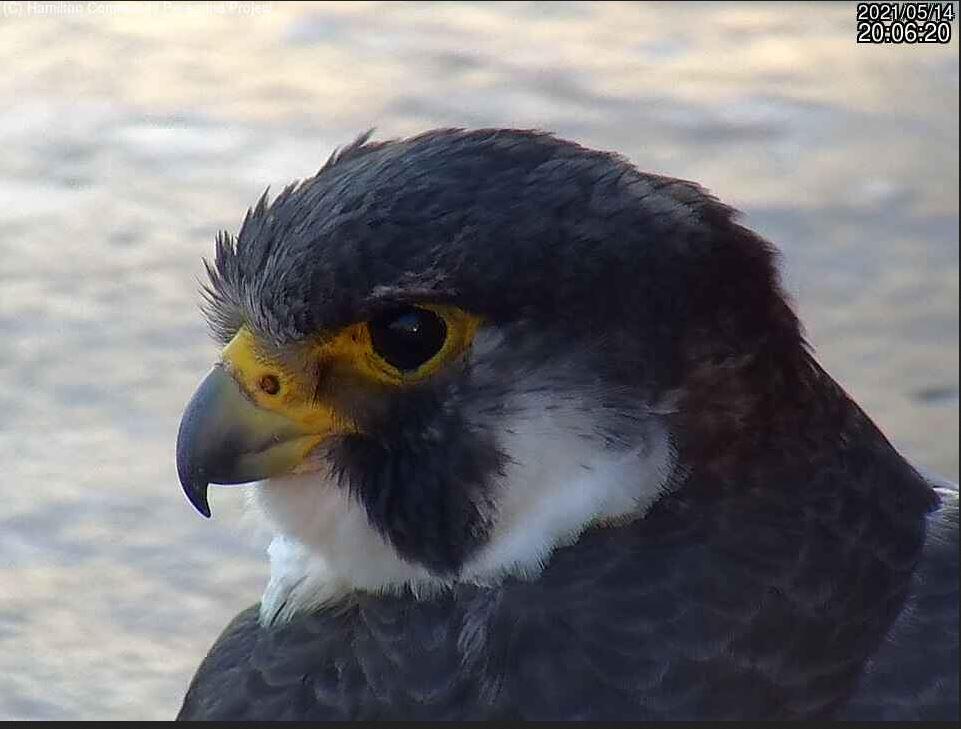
But, it is also typical behavior for before nesting season, and there is a small ray of hope. She has been allowing Judson to come closer (left photo), and he might just be eager enough to convince her to try for a second clutch. Lily has not attempted one before, but there is always a first for everything. We will watch to see if Judson starts courting her, and bringing her meals.
But things are not (yet) smooth sailing for the falcons in Hamilton. In the past week we have observed another adult in the area, spending most of its time on the BDC building, a block away from the Sheraton nest site. We have not been able to get a close enough look at this bird, so we cannot tell if it is Ossie, healing up from a previous battle, and still willing to try again, or if in fact this is a new female that was previously paired up with Judson. There were reports, in the week before Judson’s appearance, of another peregrine pair being sighted first in west Hamilton, then up near Ancaster. We don’t know if that pair moved on, or they came here.
The three of them were seen once circling the BDC building and calling to each other, but no battles have been seen. And there was one report of a fourth peregrine, seen flying away from the downtown core. So, while we may not have any chicks this year, the skies over Hamilton are going to be interesting for a while yet! If you are downtown, keep an eye on the skies. If you see anything of note, please report it to our facebook group.
Posted on May 15, 2021 12:23 pm