May 20, 2016 - Mississauga - Holcim
Mark Nash Reports:
MAY 20th - 2016
We are delighted to report that we have been able to book and confirm the banding date for the CRH Canada Group in Mississauga for June 6th at 3pm.
Stay tuned for the banding update and news!!
Posted on May 20, 2016 11:21 pm
May 19, 2016 - Mississauga - Holcim
Marion Nash Reports:
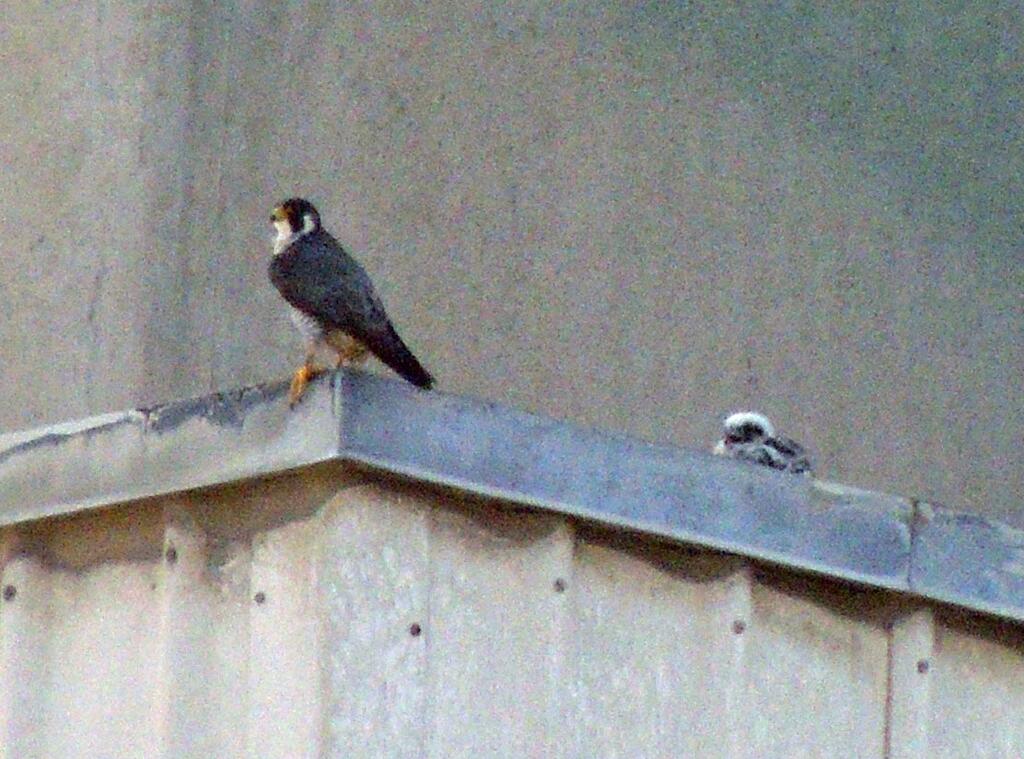
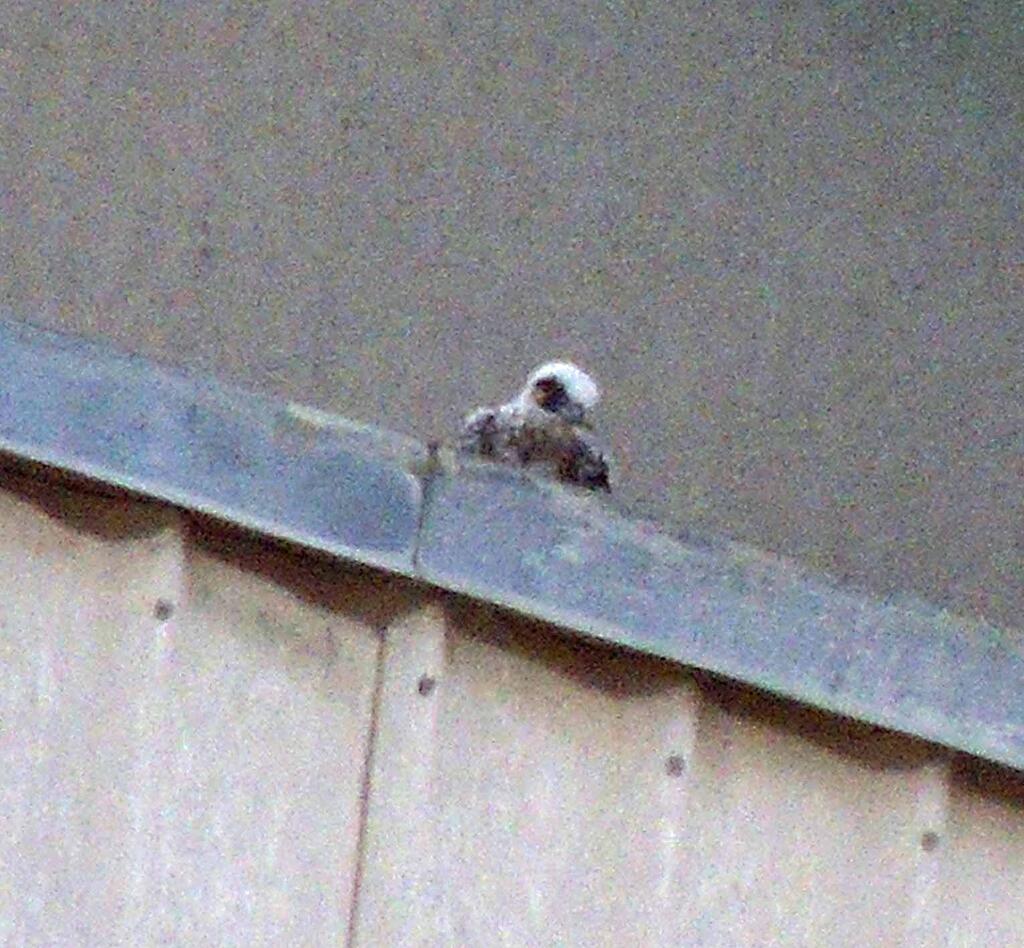
First chick hatched at CRH Canada Group Mississauga plant on May 17th. keep watching for up coming information and banding date.
Posted on May 19, 2016 2:00 pm
April 13, 2016 - Mississauga - Holcim
Marion Nash Reports:
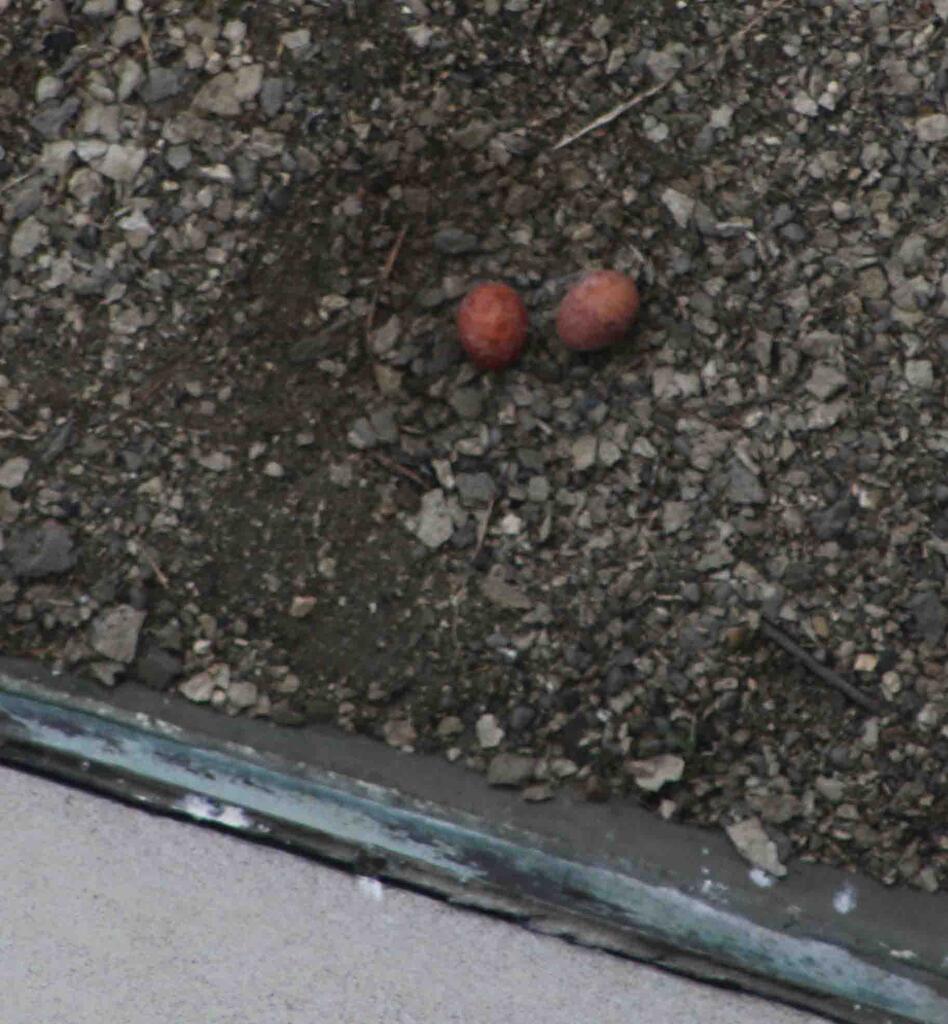
There are now 4 eggs in the nest. Barb sent a message on April 5th letting us know they had 2 eggs so I assume the first was likely laid on or about April 3rd. The female decided not to use the nice nest tray provided last year so I hope all goes well and that there will be a hatch this year.
Posted on April 13, 2016 6:00 pm
April 05, 2016 - Mississauga - Holcim
Marion Nash Reports:
On April 4th Tessa a female hatched in 2014 and banded Y 82 with red tape at the Holcim Cement plant in Mississauga and the unbanded resident female at the Statler Towers in Buffalo battled it out fighting over the nest box.
Poor Ralphie the resident male who is also a Canadian bird produced at the Downtown Toronto Sheraton Hotel in 2014 just had to get the heck out of their way and let the girls fight it out. There was at the time 1 egg in the nest and the female held her ground to protect it even though Tessa had her pinned down for several minutes until they both tumbled out to the box together. All was caught on camera and can be seen on the link below. The resident female was seen in the best the nest morning so it looks like Tessa was not successful in winning the nest this time. The DEC has installed several nest boxes at other nearby Buffalo sites so hopefully Tessa will find her own mate and pick one of the unoccupied nest boxes.
Tessa and Unbanded Female Fight Video
www.youtube.com/watch?v=-eZtpabCi30
Posted on April 5, 2016 2:16 pm
March 30, 2016 - Mississauga - Holcim
Tracy Simpson Reports:
I have been out several times in the past week checking in on the activity at Holcim. Both adults seem to be favoring the old nest box in the heart of the plant which has made identifying the pair heartily frustrating. They are both out and active with copulation ongoing so eggs will be hopefully coming. The big question is where will the eggs be laid and who are the adults. I will be back out soon to try and figure that out.
Posted on March 30, 2016 10:02 am
July 21, 2015 - Mississauga - Holcim
Mark Nash Reports:
July 21st - 2015
Again it is with great sadness that I must report that we have lost another fledgling.
As many of you know, this is the time of year when we have finished most all of the fledge watches, and the young fledgling survivors are now able to hold their altitude and stay off the ground, (and for the most parts), no longer in need of our help.
That being said, this is not entirely true, as the young fledglings are starting to investigate their new world, and straying further and further from their parents and the home territory throughout the day, and as we all know, unsupervised young children usually get into trouble.
Remembering that the young fledglings are still very much “children”- in mind, still very much dependant on their parents for food as many of them are unable to catch their own food at this point, and most all are still very inexperienced with any time type of real skilled flight, and still have allot of learning yet to do.
This is the time when they end up getting in other types of trouble. remembering that they are building up allot of speed and unable to judge distances given this speed, and end up crashing into things and/or getting stuck or caught in things. Thus is the case for little Ogden who obviously had a collision with something, and sustained serious injuries as a result.
Little Ogden was found on the ground within the plant grounds and was successfully rescued by the great Holcim staff. Unfortunately, Ogden succumb to his injuries and died shortly thereafter.
Posted on July 23, 2015 11:56 pm
July 21, 2015 - Mississauga - Holcim
Tracy Simpson Reports:
I stopped in at Holcim yesterday on my way north to check in on Ogden and his progress in flight training. I found Caspian over in the center of the plant on a railing watching the main building very closely. I found Dad on the east side of the main plant taking a nap in the shade. It took about 20 minutes for me to locate Ogden and was able to easily pick him out on the south side of the main plant with a little help from Caspian. She had taken off on a hunt to the west and when she returned, the sight of food had Ogden to his feet and screaming so loudly I could hear it all the way from Avonhead Road! Caspian dropped off the food to Ogden and then headed back to her perch on the railing. All three birds were in sight and high up so I am happy to report that since his fledge last Thursday, it would appear that Ogden is doing quite well!!
Posted on July 21, 2015 11:06 am
July 17, 2015 - Mississauga - Holcim
Tracy Simpson Reports:
I was out in Mississauga yesterday on errands and decided to stop in at the Holcim nest site as I knew that Ogden was very close to first flights. I found him on the nest ledge watching the adults and practicing his flights. He was so ready. He would have 1 or 2 minute bursts of flapping like mad and then he would finish it off by getting airborne and flapping to the end of the ledge. Each little activity session was longer and stronger than the next. He decided to head into the heart of the ledge for a nap out of my view at around 1:30pm and that’s when the adults started to wind him up. The parents starting hunting and doing fly bys past the ledge every few minutes. Ogden watched with great curiosity but did nothing about it until Dad came past with food in his clutches. That had his interest for certain!! After about 10 minutes, Dad flew in with a very small package that Ogden grabbed with gusto. He took off into the back of the ledge with it and consumed it fast. He was back on the edge of the ledge within minutes. Caspian then flew in with another tidbit but this time she didn’t relinquish it. She flew over to the short silos along Avonhead Road and ate it herself in Ogden’s view. Wow. He was furious! She then flew over to a low railing along the east side of the tall silos and waited. It didn’t take long! Ogden lost all patience and fledged making his first flight a short one but well done over to the west side of the short silos out of my view. Excellent job! Caspian didn’t leave her perch at all but instead watched him make that flight past her and land up high. I called Marion and asked her to inform the Holcim staff that Ogden was now on the loose and packed up to head north to work. Great job Ogden!
Posted on July 17, 2015 7:10 am
July 14, 2015 - Mississauga - Holcim
Tracy Simpson Reports:
Yesterday after checking in at William Osler I headed down to Holcim to see how little Ogden was doing. Margaret, one of our watchers from MEC, checks in on the site on Fridays when she is in the area and she noted that while he still bore some down he was flapping strongly and exercising very well. With her observations in mind and knowing that he is right around the perfect age for fledging, approximately 38 days now, I wanted to check in on his progress.
I found him easily enough when I arrived right on the edge of the nest ledge. He still had a downy mohawk and has still yet to fledge. I don’t blame him. The past few days have been so hot, humid and virtually windless that it would make that first flight a really tough one. He sat in the hot sun calling to his parents as he wanted breakfast regardless of the heat. Good, they are weaning him. I found Caspian up on the top rail of the central plant and the male down by the south silos. They had Ogden lined up should he take that first flight and were ready if he chose to go. Definately not much flapping today but he had that look. You know the look. The one where they settled down in their bouncing and playing and start to seriously target where that first flight is going to take them. He’s not far off from taking that flight, that’s for sure! During the time that I was there, the parents would occasionally go out on a hunt but nothing too intense or serious. It was more a hunt of opportunity. If they came up with something that was great but no real drive behind it to succeed. The male went after a flock of starlings over Avonhead Road but did not come up with anything. Caspian flew north to the heart of the quarry after some pigeons but again a half hearted chase. After each hunting attempt they returned to their perches that I originally found them on and watched Ogden. They know its soon!
I will be back later in the week and I suspect our little man may have flown by then. The Holcim staff are amazing and will also keep an eye out for Ogden. Margaret will also pop in at the end of the week for a site check. We look forward to his first flights!
Posted on July 14, 2015 10:49 am
July 04, 2015 - Mississauga - Holcim
CPF Postmaster Reports:
July 4th - 2015
A big thank you to Lucie who was making the rounds and ended up at stopping in at the Holcim plant to do a quick spot check on Ogden. Despite the challenges with the distances and the sun in her face (and her camera lens), she was able to capture some shots of little Ogden and a parent having a typical family moment.
For all of the peregrine watchers and those parents that have small babies, you know all about these special moments that we’re talking about,, baby screams, parent attends, baby screams, parent attends,, baby screams, parent attends, baby screams and screams and screams and screams and screams, parent attends, attends, attends, attends, attends 
Posted on July 5, 2015 1:11 pm