June 19, 2022 - Toronto - Mount Sinai Hospital
Marion Nash Reports:
Red has pulled off her red tape need a name for her. pictures from her second release. She and her siblings are flying high now hope we can wind down the watch today.
Posted on June 19, 2022 12:07 pm
June 17, 2022 - Toronto - Mount Sinai Hospital
Marion Nash Reports:
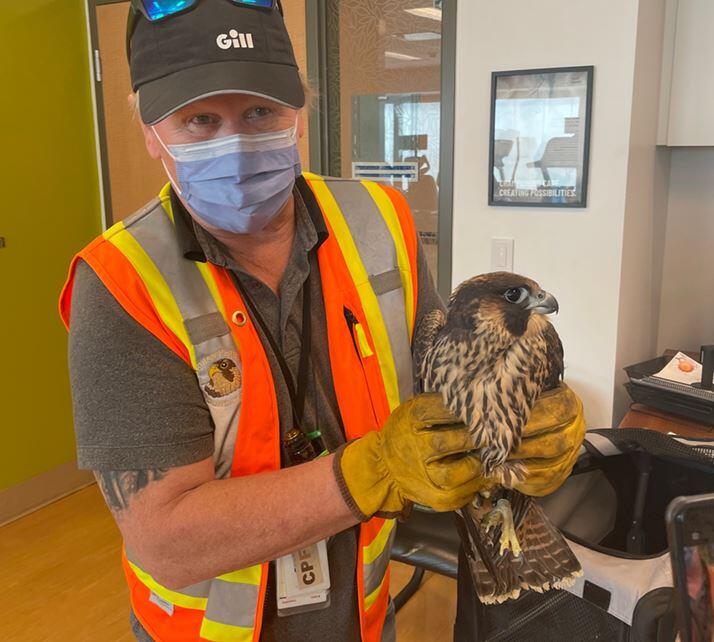
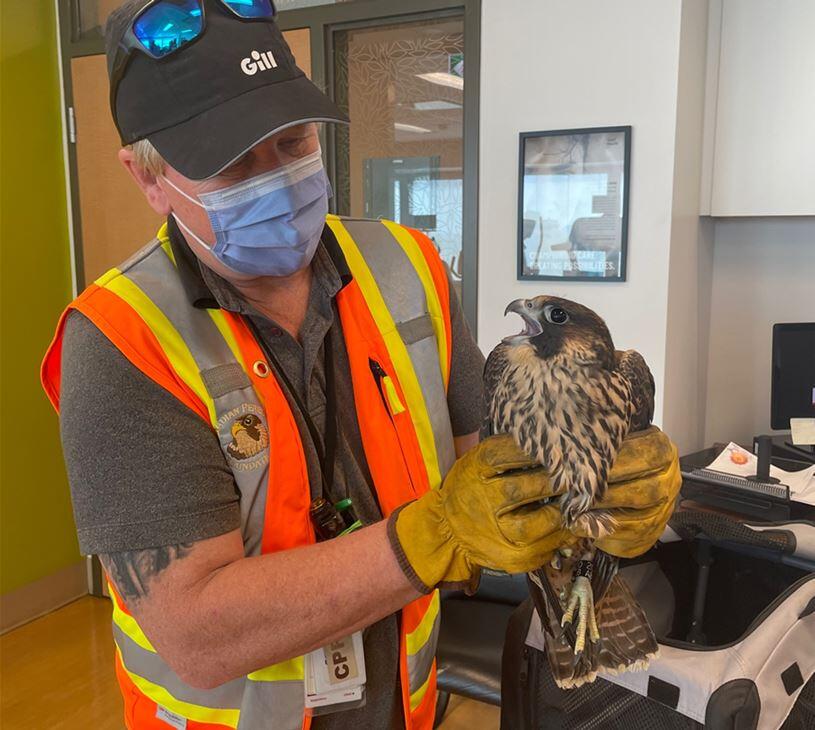
Photos of released fledgling at Mount Sinai Hospital as promised. pictures taken by Tracey Clatworthy
Bruce Reports the other 2 fledglings flying well. Lets hope Red who has now picked off her red tape keeps her altitude and improves.
Posted on June 17, 2022 11:05 pm
June 17, 2022 - Toronto - Mount Sinai Hospital
Marion Nash Reports:
Mt Sinai Hospital
June 16th - 2022 - AM Report
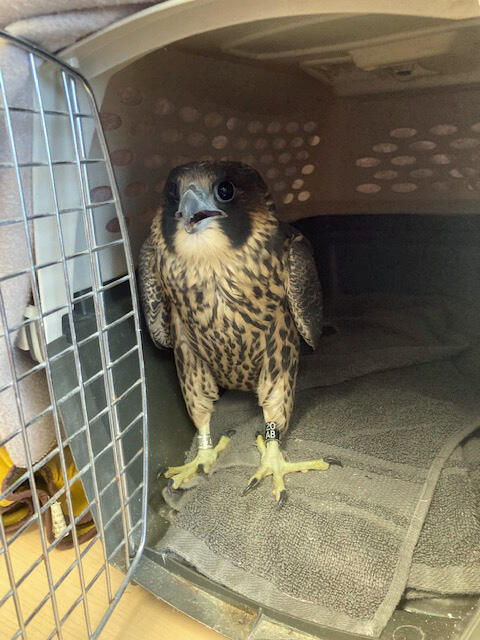
We received a call from TWC that one of the fledglings from the Mount Sinai nest was brought in by Toronto Animal Services. The fledgling was fine and cleared to be released so we drove up to Downsview and met Mark Heaton there and banded the fledgling. Clearly weighing in as a female at 1001 grams. She was outfitted with red tape on the silver band and Black banded with the Canadian SOLID BLACK band number 20 over AB.
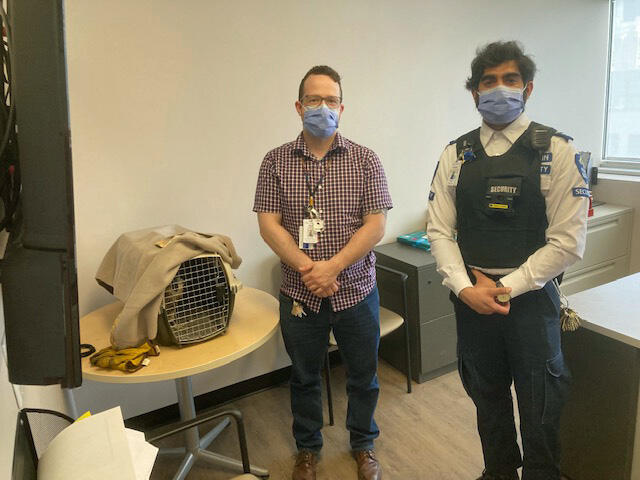
It is much easier to spot a color band from the ground during the fledge watch. Bruce Massey remained on site on the flede watch as we got down to the Hospital and continued his watch from the ground as Mark Nash did the release back on the roof. She did make one flight later and kept her height so all was well at the close of the day. The Mt. Sinai fledge watch continues as per the norm until all three of the offspring have clearly demonstrated that they can hold their altitude and don’t need to be rescued from the ground. A big thank you again to all of the Mt. Sinai staff and their security personnel for all of their assistance and support with access to their facility to get the young fledgling back to the upper roof elevation and back to its parents care.
Photos to follow….
———————————————————————————————————————————————————–
Mt. Sinai Hospital
June 17th - 2022
June 17th AM - Yet another call call this morning from Toronto Animal Services that one of the fledglings was down on a planter at street level in the middle of University Ave., wonderding around looking confused and unable to get altitude back to the safety of the ledges. So I called Bruce who was on site on the fledge watch at the Hospital and the two of them were successful in rescuing the fledgling. The young fledgling was clearly identified as the same fledgling that was rescued from the streets yesterday - (June 16th - Black banded 20 over AB with the Red tape identifier). She will be held at security until later today for observation and if there is no sign of injury, we will release her back to the roof and to her parents care.
Photos to follow……….
Posted on June 17, 2022 12:22 pm
June 28, 2021 - Toronto - Mount Sinai Hospital
Marion Nash Reports:
Mount Sinai report- Arrived Saturday morning early to find both juveniles Had fledged. One Male (Kelly- Named by a member of the Public), and 1 Female, found on the Rehab Hospital Roof (Named - Bresa. - Spanish for Breeze) Named by me). Kelly did well, and was active throughout the day. Bresa not so much. Until 6:00 PM. She stayed on that rooftop. After that she made a series of Flights attempting to get back to the Nest Ledge. She didn’t make it, but gained a lot of flight experience. Mom finally had enough and she put her to Bed on one of the lower ledges for the night.
Kelly also spent the night on Ledge, but this was one window level under the Nest Ledge Level.
Fledge Watch- Mon. Jun. 21, 2021
I spent most of Monday morning watching the bird down on West side of Sick Kids Hospital just above the entrance thinking it was Kelly the male juvenile. But at around 12:30 when I came to the Street It was the female Bresa. I fortunately managed to Chase her off of University and she flew down elm street about 3/4 the length of the Toronto Sick Kids Hospital. She was then flushed from the sidewalk and flew up about 25′ to the top of a construction site gate. Is there a block for you when I was until she flew back in a couple of flights to outer side around the Southwest corner of the Is Sick Kids Hospital. As with the night before she disappeared and I didn’t find her before I went home. I didn’t have any indication that she was down or anything and as I laughed I had 3 falcons on the top nest ledge level and I could hear some Vocalizing. The problem was I had a 25 or 30 km or wind which caused the Sound to be going around.
Wednesday June 23, 2021
FLEDGE REPORT
Found both Juveniles on different levels of the Peter Monk Center. One Adult was in attendance. About an hour later, Brisa flew down to edge for a rest. About 2 Hrs later she had disappeared. Around 1:30 PM, I had a Juvenile fly from North end of Mt. Sinai S. It looped around and landed on A South Ledge. The landing was a little shake, but much to my surprise this was Brisa. She then flew around the Southwest corner and to the rooftop level. There she had reunion with her brother. The adult Female checked them out. She made a couple of good flights. One of them was an attempt to land on the new Princess Margaret (CD Rack) Structure on the roof top, she didn’t succeed but flew well & landed back on the Mt Siani roof. Later on she was seen on roof and flew down to Multiple ledges just below the Roof. Both Juveniles were tucked into Bed by 8:00 PM, so took advantage and called it an early Night. Also since she was flying so we’ll and staying high I also called the Day to Day watch concluded and it will be OK to Spot Check site.
Posted on June 28, 2021 11:19 am
June 20, 2021 - Toronto - Mount Sinai Hospital
Bruce Massey Reports:
Arrived Saturday morning early to find both juveniles Had fledged. One Male (Kelly- Named by a member of the Public), and 1 Female, found on the Rehab Hospital Roof (Named - Bresa. - Spanish for Breeze) Named by me). Kelly did well, and was active throughout the day. Bresa not so much. Until 6:00 PM. She stayed on that rooftop. After that she made a series of Flights attempting to get back to the Nest Ledge. She didn’t make it, but gained a lot of flight experience. Mom finally had enough and she put her to Bed on one of the lower ledges for the night.
Kelly also spent the night on Ledge, but this was one window level under the Nest Ledge Level.
Posted on June 20, 2021 11:19 am
June 16, 2021 - Toronto - Mount Sinai Hospital
Marion Nash Reports:
Bruce and Mark have confirmed there are at least 2 chicks at Mt Sinai Hospital. Should be ready to fledge in about a week. As for The Sheraton Hotel it’s a fail, both eggs have been abandoned one is broken no hatch this year, no sign of chicks at 18 King St.
Posted on June 16, 2021 10:21 am
April 01, 2020 - Toronto - Mount Sinai Hospital
Harry Crawford Reports:
At just before 11am as I approached from the north, a peregrine flew into
the nest ledge. It left a few minutes later and then came back after 10
minutes with food and left it in an adjacent ledge and took off again. It
looks like this site is active again this year.
Interestingly, I spotted Hunter on the west side of the CIBC building at
Yonge & Bloor around 4 pm yesterday. Doing well for an old bird.
Posted on April 1, 2020 4:27 pm
January 20, 2020 - Toronto - Mount Sinai Hospital
Harry Crawford Reports:
This is 5:15pm and I have Hunter on the south side of the CIBC building.
He was here in the same spot and time yesterday and was with Ariel at the
same location a few days before that. This is significant because Hunter
hasn’t been seen in the area for close to a month. He is 21 now and I was
a bit concerned. Some aerial activity has been seen southeast of Yonge &
Bloor so they may be hanging around the new condos in the area.
Posted on January 22, 2020 12:18 pm
July 08, 2019 - Toronto - King Street
Linda Woods Reports:
July 8th early evening.
Did a spot check on the Sheraton and only saw one peregrine. Can’t be sure if it was a juvie, sitting on the north/west corner of a building at Queen and Bay St.
I took a quick look around Mt.Sinai area and didn’t see any activity. They all must be out flying around with the Adults.
King St.
One adult on the south service area of 18 King St, cleaning prey. Later it was seen on the north east corner of the Dynamic building. I still think it’s Stormin and Chaos coming to this area. I was hoping to see perhaps Quinn or Bonvoy follow Stormin over to King St., have to wait and see if that happens.
Posted on July 13, 2019 10:53 am
July 05, 2019 - Toronto - Mount Sinai Hospital
Marion Nash Reports:
A brief update on our injured juvenile rescued at the Sick Kids Foundation off of their balcony. X-rays show no fractures and he is responding well to pain management and inflammation treatment. Looks like this little man might be going home soon if all goes well. Thank you to everyone involved in his rescue. Looks like he may get a second chance thanks to all of you. Fingers crossed!! We’ll know more later today.
Posted on July 5, 2019 11:06 am